Are you spending time and money on digital marketing without knowing what works?
You keep investing in campaigns, content and tools, but cannot clearly connect your efforts to enquiries, customers or revenue.
Find out what’s missing
DIGITAL GROWTH & COMMUNICATION STRATEGY
Explore the challenges I can help you solve, and see the practical steps behind each solution.
Explore the problems I solve
Your business may be facing challenges that are not immediately obvious. The three pain points below may sound familiar. Explore the specific business problems further down the page to find what might be holding you back.
You keep investing in campaigns, content and tools, but cannot clearly connect your efforts to enquiries, customers or revenue.
Find out what’s missingYour website may look professional, but it isn’t attracting enough relevant visitors, generating enquiries or converting interest into business.
Discover what’s holding it backPotential customers may not find you on Google or social media, understand what you offer, or know how to contact you.
Explore the visibility gapsExplore the 43 business problems below to identify what may be holding your business back.
Common problems are highlighted in muted gold.
I want to build a website, but I don’t know where to start.
Explore SolutionI have a website, but I don’t know whether Google can find it.
Explore SolutionMy website is slow, especially on mobile. Am I losing potential customers?
Explore SolutionMy website looks good on desktop, but it doesn’t work properly on mobile.
Explore SolutionPeople visit my website, but why aren’t they contacting me?
Explore SolutionMy website has all the information, but visitors struggle to find what they need.
Explore SolutionMy website is running, but I don’t know what’s working and what isn’t.
Explore SolutionMy business is growing, but can my website grow with it?
Explore SolutionI want to sell my products or services online, but I don't know where to start.
Explore SolutionI have a website, but people searching for my services on Google cannot find it.
Explore SolutionMy competitors appear above me on Google. How can I get my business noticed?
Explore SolutionI regularly publish blogs and articles, but hardly anyone reads them.
Explore SolutionMy website appears on Google, but very few people click on it.
Explore SolutionWhen people ask ChatGPT, Gemini or other AI tools about services like mine, my business never gets mentioned.
Explore SolutionMy business serves customers nearby, but people cannot find it on Google Maps.
Explore SolutionI create YouTube videos, but very few people discover or watch them.
Explore SolutionI spend time and money trying to attract customers through Google, but I don’t know whether it’s helping my business.
Explore SolutionMy business graphics look different everywhere, and I don’t know how to make them consistent.
Explore SolutionI want professional posters, social media graphics and presentations, but I don’t know what will work.
Explore SolutionI have photographs and videos, but they don’t look professional enough to publish.
Explore SolutionI want to create videos for my business, but I don’t know how to plan, record or edit them.
Explore SolutionPeople see my graphics and videos, but they don’t seem to understand the message.
Explore SolutionI want to promote my business on Facebook, Instagram and LinkedIn, but I don’t know where to start.
Explore SolutionI regularly post on social media, but hardly anyone sees my posts.
Explore SolutionMy posts receive likes and comments, but very few people contact my business.
Explore SolutionI don’t know what to post or what my potential customers want to see.
Explore SolutionI want to advertise on Facebook, Instagram or LinkedIn, but I don’t know whom to target.
Explore SolutionI’m spending money on social media advertisements, but I don’t know whether they’re bringing me customers.
Explore SolutionMy competitors seem to attract more attention on social media, even though we offer similar services.
Explore SolutionI manage several social media accounts, but I struggle to maintain consistent content and branding.
Explore SolutionI get visitors to my website, but I don’t know what they do after arriving.
Explore SolutionI receive enquiries, but I don’t know whether they come from Google, Facebook, Instagram or LinkedIn.
Explore SolutionI spend money on advertisements, but I don’t know which ones bring customers.
Explore SolutionPeople visit my website, but many leave without contacting me.
Explore SolutionI have reports from several platforms, but I can’t understand what the numbers mean.
Explore SolutionI keep changing my website and advertisements, but I don’t know whether the changes are helping.
Explore SolutionI spend hours repeating the same tasks every day. Can some of this work happen automatically?
Explore SolutionI use several applications, but they don’t share information with one another.
Explore SolutionI receive customer enquiries through different channels and struggle to manage them.
Explore SolutionI want to use AI in my business, but I don’t know where it would actually help.
Explore SolutionI have large amounts of information that take too much time to organise and analyse.
Explore SolutionI need a website feature or application that existing software cannot provide.
Explore SolutionI want to send timely updates and responses to customers without doing everything manually.
Explore SolutionSERVICE 01 / 06
Your website should attract relevant customers, explain your services clearly and help visitors take action. I plan customer journeys, develop practical website features, improve mobile performance and accessibility, support search discoverability and measure enquiries. This service includes website planning, technical readiness, performance improvements, lead-generation experiences and e-commerce development, with a focus on customer needs and business outcomes.

WEBSITE DEVELOPMENT & UX · SOLUTION 01
You want to build a website. Let's make sure it generates revenue for your business.
You want a website for your business, but may not know where to begin, what features you need or how to ensure that your investment attracts customers and generates enquiries.
We combine website development, SEO, user experience and communication strategy to create websites designed to attract relevant customers, increase business enquiries, and generate revenue.
Your website's success begins with understanding your customers. Who are they? What are they searching for? What information do they need before choosing your services?
Tools such as Google Keyword Planner and Google Trends help identify relevant searches, understand customer interests and recognise changes in demand. Competitor research reveals how other businesses present their services and where opportunities may exist.
I identify high-value keywords, analyse customer search intent and uncover opportunities your competitors may be missing. This helps your website attract relevant visitors actively searching for your services.
I develop an SEO-optimised website architecture with strategically structured service pages, URLs, metadata and internal links. As a result, your website becomes easier for search engines to understand and for potential customers to navigate.
I also design conversion-focused customer journeys with persuasive content, trust signals and strategically placed calls to action. Consequently, your website is better positioned to convert interested visitors into qualified enquiries and potential customers.
Your website shouldn't just attract visitors. I help turn that attention into qualified enquiries and opportunities for measurable business growth.
Your customers may describe their needs differently from the terminology your industry uses. I connect the words they search for with clear service descriptions, relevant headings and persuasive calls to action.
As a result, your visitors can recognise that your business understands their needs, find relevant answers and feel more confident about contacting you.
Once development begins, your website must perform reliably across mobile phones, tablets and desktops. Slow loading, confusing navigation and inaccessible content can discourage potential customers before they even explore your services.
Google PageSpeed Insights and Lighthouse help identify technical problems affecting loading speed, accessibility and usability. Core Web Vitals measure important aspects of the visitor experience, including loading performance, responsiveness and visual stability.
I diagnose Core Web Vitals issues, inefficient image loading, unnecessary scripts and other performance bottlenecks. By addressing these issues, I help your website load faster, respond more smoothly and deliver a more reliable browsing experience.
I optimise image delivery, caching, resource loading and responsive layouts, while validating accessibility and performance across devices. These improvements make your website more accessible, mobile-friendly and easier for potential customers to use.
I also refine navigation, visual hierarchy, content presentation and important customer interactions. With fewer obstacles in their journey, visitors can find relevant information quickly and move towards enquiries, bookings or purchases more easily.
A better website experience gives customers fewer reasons to leave. I remove technical and usability barriers so your website can turn more visits into meaningful business opportunities.
My experience in communication and training allows me to translate complex services into clear, persuasive explanations, organise information around customer needs and develop messages that encourage confident decisions.
As a consequence, your visitors can understand your services quickly, navigate your website confidently and make informed decisions about contacting your business.
A professionally designed website has limited business value if potential customers cannot find it. Search engines need to discover your pages, understand their content and recognise which customer searches they are relevant to.
Google Search Console helps investigate how Google discovers and indexes your pages. XML sitemaps, internal linking and Schema.org structured data strengthen technical foundations, while relevant titles, headings and content make your services easier to understand.
I investigate crawling, indexing, sitemap and canonicalisation issues through Google Search Console, identifying technical obstacles affecting important pages. Addressing these barriers gives your website a stronger foundation for appearing in relevant search results.
I implement appropriate Schema.org structured data, validate its accuracy and strengthen internal linking and technical SEO. These improvements make it easier for search engines to understand your business, its services and the relationships between your pages.
I optimise page titles, meta descriptions, headings and content around customer search intent. In turn, your website is better positioned to reach potential customers looking for solutions your business provides.
Your customers are already searching for answers. I help make your website a relevant, discoverable destination when they're looking for services like yours.
I also connect the language customers use when searching with the words they encounter on your website. This creates a stronger relationship between your SEO strategy, website experience and conversion-focused messaging.
Consequently, potential customers can find information that matches their searches, understand your services clearly and move more confidently towards making an enquiry.
Launching your website is the beginning of its growth journey, not the end. You need to understand how visitors discover it, which services attract attention and what encourages people to contact your business.
Google Analytics 4 and Google Tag Manager help measure important website interactions. Google Search Console reveals search performance, while Looker Studio brings relevant findings together into understandable reports.
I configure and validate tracking for form submissions, telephone clicks, WhatsApp enquiries and other important interactions using GA4 and Google Tag Manager. This allows your website to measure meaningful customer engagement and identify potential lead-generation opportunities.
I combine search, traffic and conversion information into actionable reports, identifying underperforming pages and where visitors abandon their journey. Based on this evidence, I can prioritise improvements that address real customer behaviour rather than assumptions.
I refine service messaging, navigation, calls to action and conversion pathways based on observed performance. Over time, these changes can help your website convert more relevant visits into qualified enquiries and business opportunities.
Your website should improve with every meaningful insight. I turn performance data into practical decisions that support stronger conversions and sustainable business growth.
My experience in communication and training helps me translate complex services into clear, persuasive customer-facing messages, structure information logically and develop calls to action that encourage meaningful engagement.
As a result, your business can recognise where customers struggle, improve important messages and create clearer pathways towards meaningful enquiries.
For businesses that need deeper competitive intelligence, platforms such as Semrush, Ahrefs and Ubersuggest can reveal additional information about competing websites, valuable search opportunities, keyword gaps, backlink profiles and content performance.
I conduct detailed competitor research to understand how competing businesses structure their websites, communicate their services and attract search traffic. I identify gaps in their content, keyword coverage and customer journeys that your business may be able to address. This helps you discover opportunities to differentiate your services and reach relevant customers your competitors may be overlooking.
I analyse valuable search queries, keyword difficulty, competing pages and relevant backlink opportunities to prioritise topics and pages with stronger commercial potential. I connect these findings with your services, geographic markets and customer needs rather than pursuing traffic for its own sake. As a result, your business can focus its content and SEO investments on opportunities more likely to attract qualified visitors and generate enquiries.
I translate the research into a practical website and content improvement plan, covering priority service pages, information gaps, internal linking opportunities and appropriate measures of progress. I also review results periodically to identify changes in demand and competitive activity. Consequently, your business can make better-informed digital investments, strengthen its competitive position and pursue sustainable business growth.
Advanced research is valuable only when it leads to better business decisions. I connect competitive intelligence with customer understanding and a clear plan to attract relevant customers, increase business enquiries and generate revenue.
Let's build one that actively works to attract customers, generate enquiries and drive measurable business growth.
Ready to make your website work harder for your business?
WEBSITE DEVELOPMENT & UX · SOLUTION 02
Your website is slow, especially on mobile. Let's make it faster, smoother and easier for customers to use.
A slow website can frustrate visitors, interrupt their browsing experience and cause potential customers to leave before they explore your services.
We investigate the technical and usability issues affecting your website and implement targeted improvements to make it faster, more responsive and easier to navigate across devices.
Before improving your website's speed, we need to understand what is causing the delays. Large images, inefficient code, unnecessary scripts, slow server responses and poorly optimised resources can affect how quickly your website loads and responds.
Google PageSpeed Insights and Lighthouse help identify performance problems and opportunities for improvement. Core Web Vitals provide measurements of loading performance, responsiveness and visual stability. Browser developer tools help investigate network requests, scripts, images and rendering behaviour.
I conduct technical performance audits to identify slow-loading resources, inefficient scripts and rendering bottlenecks. This helps me identify the specific problems affecting your website rather than applying generic optimisation measures.
I examine Core Web Vitals, server response times, image delivery and third-party resources to determine which issues have the greatest impact on users. This allows me to prioritise improvements that can make a meaningful difference to your visitors' experience.
I develop a practical optimisation plan based on technical findings, customer impact and implementation priorities. Consequently, your business can invest effort in improvements that matter most instead of making unnecessary changes.
A faster website begins with an accurate diagnosis. I identify the barriers affecting performance and build a targeted plan to improve the experience your customers receive.
Technical performance findings can be difficult for business owners to interpret. I explain these issues in straightforward language, distinguish urgent problems from minor recommendations and connect proposed improvements to customer experience and business priorities.
Because of this, you can understand what needs to be improved, why it matters and which changes deserve your investment.
Once we identify the causes of poor performance, we need to address them systematically. Your website should load essential content quickly, respond smoothly to interactions and avoid unnecessary delays as visitors move between pages.
Image compression and modern image formats reduce unnecessary file sizes. Browser caching, efficient resource loading and appropriate content delivery strategies can improve loading performance. Code optimisation, script management and hosting configuration also influence how efficiently a website operates.
I optimise images, fonts and other page resources, adjusting their loading behaviour to reduce unnecessary data transfers. This helps your website display important content more quickly and provide a smoother experience for visitors.
I investigate unnecessary JavaScript, inefficient CSS, rendering delays and caching configurations, implementing improvements appropriate to your website's technology. As a result, your pages can respond more efficiently and reduce avoidable waiting times.
I evaluate hosting-related limitations, server responses and performance across important page templates. By addressing these constraints, I help establish more dependable website performance as your content and business requirements grow.
Your customers shouldn't have to wait for your website to work. I improve its technical efficiency so they can spend more time exploring your services and less time waiting for pages to load.
Website speed is also affected by how information is presented. I organise important messages, headings and calls to action so customers can understand your services without depending on heavy visual effects or unnecessary content.
Because of this, visitors can find essential information sooner, understand your services more easily and move towards the next action with fewer distractions.
A website can load quickly and still be difficult to use. Small buttons, crowded layouts, shifting elements, confusing navigation and hard-to-read text can make browsing frustrating, particularly on mobile phones.
Responsive design techniques help layouts adapt to different screen sizes. Lighthouse accessibility checks, browser device emulation and practical device testing help identify usability barriers. Core Web Vitals and layout-stability diagnostics provide additional evidence about how pages behave during loading and interaction.
I refine responsive layouts, typography, spacing, image sizing and interactive elements across mobile, tablet and desktop views. These improvements help your customers read content comfortably and use your website without unnecessary scrolling, zooming or visual confusion.
I investigate layout shifts, touch-target problems, navigation difficulties and accessibility barriers. Addressing these issues makes it easier for visitors to explore your services, complete forms and interact with important website features.
I optimise the visibility and usability of contact buttons, enquiry forms and conversion pathways on smaller screens. With fewer obstacles, mobile visitors can contact your business more conveniently and complete important actions with greater confidence.
Your mobile website should make doing business with you easier, not harder. I remove usability barriers so customers can explore your services and reach you without unnecessary effort.
Mobile visitors need information that is easy to scan and understand. I use concise, familiar language, clear headings and logically organised content rather than lengthy explanations, flowery expressions or unnecessary technical terminology.
Because of this, customers can identify relevant services quickly, understand their options and take action without navigating through confusing information.
Website optimisation should not end after fixing a few technical problems. Software updates, new content, additional features and third-party services can affect performance over time. We need to measure the improvements and monitor whether your website continues to perform reliably.
PageSpeed Insights and Lighthouse support repeated performance assessments. Google Search Console provides Core Web Vitals reporting based on available field data, while GA4 helps analyse website engagement and important user interactions. Performance comparisons require consistent testing conditions and attention to both laboratory and real-user measurements.
I establish performance baselines and compare loading, responsiveness and visual-stability measurements after optimisation. This enables your business to evaluate whether the implemented changes produce measurable technical improvements.
I examine engagement patterns and important customer interactions to understand whether performance improvements accompany better website experiences. These findings help identify remaining obstacles that may discourage visitors from exploring services or making enquiries.
I recommend periodic performance reviews and checks after significant website changes, prioritising issues according to their impact. This supports more consistent website performance and reduces the risk of unnoticed deterioration.
Website performance is an ongoing business responsibility. I turn technical measurements and customer behaviour into practical improvements that keep your digital presence working effectively.
Technical scores alone do not explain whether visitors are receiving a better experience. I translate performance findings into clear business language, explain the improvements and connect customer-behaviour observations to practical decisions.
As a consequence, you can understand the value of the improvements, identify priorities and make informed decisions about your website's continued development.
For businesses requiring deeper performance analysis and continuous monitoring, specialist platforms such as GTmetrix, WebPageTest, DebugBear, SpeedCurve and New Relic can provide detailed loading diagnostics, real-user performance measurements, historical comparisons and alerts when website performance deteriorates.
I use GTmetrix and WebPageTest to investigate detailed loading behaviour, identify slow resources and compare performance under relevant devices, networks and test conditions. I connect these findings with customer-facing pages and prioritise the problems most likely to disrupt important journeys. This helps your business focus optimisation work on issues that affect real website usability rather than isolated test scores.
I evaluate ongoing performance information from platforms such as DebugBear and SpeedCurve, including relevant Core Web Vitals trends, historical comparisons and real-user measurements where available. I investigate recurring delays and performance deterioration after website updates. As a result, your business can recognise emerging problems sooner and maintain a more dependable experience for potential customers.
Where website complexity warrants it, I use appropriate New Relic monitoring to investigate frontend errors, application bottlenecks and interactions between website components. I translate technical diagnostics into a prioritised improvement plan, considering implementation effort, business importance and ongoing monitoring costs. Consequently, your business can make more informed technical investments and reduce avoidable disruptions to customer enquiries.
Advanced performance research should result in practical improvements, not more technical reports. I connect specialist diagnostics with customer experience and commercial priorities to help your website remain fast, accessible and reliable.
Let's make it faster, more responsive and easier to navigate so visitors can explore your services and contact your business without unnecessary obstacles.
Ready to improve your website's speed and customer experience?
WEBSITE DEVELOPMENT & UX · SOLUTION 03
People visit your website but don't contact you. Let's turn more visitors into genuine enquiries.
Your website may be attracting visitors, but they leave without calling, sending a message or submitting an enquiry. Unclear information, confusing navigation or poorly placed calls to action may be preventing them from taking the next step.
We examine how visitors interact with your website, identify barriers to enquiry and improve the customer journey so that interested visitors can understand your services and contact you more easily.
Before making changes, we need to understand how visitors interact with your website. Which pages do they explore? Where do they hesitate? What prevents them from completing an enquiry?
Google Analytics 4 helps analyse traffic sources, engagement and important visitor actions. Microsoft Clarity provides heatmaps, session recordings and behavioural insights that help reveal scrolling patterns, confusing interactions and points of friction. Google Tag Manager supports measurement of relevant website events.
I analyse visitor journeys, traffic sources, landing pages and engagement patterns to identify where potential customers lose interest. This helps your business understand which stages of the customer journey need attention.
I examine heatmaps, session recordings and interaction data to identify confusing navigation, overlooked calls to action and usability barriers. These findings reveal where changes may make your website easier to use and enquiries easier to complete.
I distinguish problems affecting visitor quality from problems affecting website experience and messaging. Consequently, your business can prioritise improvements based on evidence rather than assumptions.
I identify where interest turns into hesitation, so we can address the barriers standing between your visitors and your business.
Customer behaviour becomes more useful when it is interpreted alongside what visitors are trying to understand. My experience in communication helps me identify where explanations, service descriptions and calls to action may be unclear or incomplete.
Because of this, your business can communicate more clearly at the points where potential customers need reassurance or direction.
Visitors are more likely to contact you when they understand what you offer and why your business is suitable for their needs. Your website must communicate its value clearly, answer important questions and provide credible reasons to trust your services.
Customer search-intent analysis, on-page content reviews, competitor research and user-behaviour observations help identify gaps in service communication. Information architecture and conversion-focused content design help organise service details, supporting evidence and calls to action.
I refine service descriptions, headings and value propositions around the needs and questions of prospective customers. This allows your business to explain its services more clearly and demonstrate their relevance to the right audience.
I organise essential information, service benefits, authentic credentials and supporting evidence into a logical sequence. This helps visitors evaluate your expertise and develop greater confidence in your business.
I position relevant FAQs, genuine testimonials where available and contextual calls to action at appropriate stages of the customer journey. Consequently, potential customers can resolve common doubts and identify a suitable next step more easily.
Customers need compelling reasons to choose your business. I make your expertise easier to understand, your value easier to recognise and your next steps easier to follow.
Effective persuasion does not require complicated language or exaggerated promises. I use straightforward, customer-focused explanations that connect your services to real needs, while maintaining a consistent and credible business message.
Because of this, visitors can understand what makes your services relevant, trust the information presented and approach your business with greater confidence.
Even interested customers may leave when enquiry forms are complicated, contact options are difficult to find or the next step is unclear. Your website should make contacting your business simple, convenient and relevant to each visitor's needs.
Conversion-focused UX design examines the visibility, placement and usability of enquiry forms, contact buttons and important interactions. Form validation, responsive layouts, click-to-call links, WhatsApp contact links and event tracking help create and assess accessible contact pathways.
I improve the placement, wording and visibility of calls to action across relevant service pages. This helps visitors recognise the next step and contact your business without searching unnecessarily.
I simplify enquiry forms, remove avoidable fields and address validation or usability problems while retaining information needed for meaningful follow-up. These changes can reduce unnecessary effort and make it easier for interested customers to submit enquiries.
I integrate suitable telephone, WhatsApp, booking or contact options into the customer journey and check their functionality across devices. As a result, visitors can choose a convenient method of communication and connect with your business more easily.
When customers decide to contact you, your website should make that decision easy to act on. I remove unnecessary obstacles between their interest and your business.
Calls to action should tell customers what happens next, using familiar language rather than vague or forceful promotional statements. I align button labels, supporting explanations and form instructions with the visitor's immediate intention.
Because of this, potential customers can understand what action to take, what to expect afterwards and how to contact you with confidence.
Improving your website requires more than changing its design or adding contact buttons. We need to measure which interactions lead to enquiries, evaluate whether changes are helping and continually refine the experience based on evidence.
Google Analytics 4 and Google Tag Manager support measurement of form submissions, click-to-call interactions, WhatsApp clicks and other key events. Microsoft Clarity adds behavioural context, while Looker Studio can consolidate findings into understandable reports. Controlled A/B testing can compare alternatives when sufficient traffic and appropriate measurement are available.
I configure and validate tracking for important contact interactions and lead-generation events. This gives your business clearer visibility into which website activities result in measurable customer interest.
I analyse engagement, enquiry activity and conversion pathways across relevant traffic sources, pages and devices. This helps identify which areas perform effectively and which may require further improvement.
I develop and assess changes to page structure, messaging, forms and calls to action, using controlled tests where appropriate. Over time, this enables your business to improve conversion opportunities through evidence-led decisions.
More website traffic isn't always the answer. I help your business make better use of the relevant visitors it already attracts.
Performance figures become valuable when they lead to decisions. I translate conversion and customer-behaviour findings into clear explanations, identify where messaging should improve and develop communication changes that can be evaluated against actual visitor actions.
As a consequence, your business can make informed improvements to customer communication and assess whether those changes encourage more meaningful enquiries.
For businesses requiring deeper conversion analysis, specialist platforms such as VWO, Optimizely, Hotjar and Contentsquare can support controlled experimentation, customer-feedback research and detailed analysis of digital journeys. Tool selection depends on traffic volume, business complexity and the available budget.
With access to appropriate specialist platforms, I can design structured conversion experiments, examine customer behaviour in greater detail and compare alternative page experiences. This helps your business identify effective improvements, reduce avoidable enquiry barriers and make better-informed decisions about conversion optimisation.
Platform selection and features should be verified against the subscriptions actually available before publishing.
Let's turn customer interest into meaningful conversations by improving your messaging, removing enquiry barriers and making it easier for potential customers to contact your business.
Ready to turn more website visits into business enquiries?
WEBSITE DEVELOPMENT & UX · SOLUTION 04
Your website looks fine, but customers cannot find it on Google. Let's improve its visibility.
You may have invested in a professional website, but it isn't appearing when potential customers search for your products or services. Search engines may struggle to discover, understand or index your pages effectively.
We identify the technical, structural and content-related issues affecting your website's discoverability and improve its search readiness so that the right customers have a better chance of finding your business.
Before improving search visibility, we need to establish whether Google can access your website and which pages it has included in its search index. Technical restrictions, incorrect settings, duplicate URLs or weak internal linking may prevent important pages from being discovered or indexed.
Google Search Console helps investigate indexing status, crawling issues and page-discovery problems. XML sitemaps identify important URLs, while robots.txt directives, meta robots tags and canonical URLs influence how search engines access and interpret website pages. Screaming Frog can provide deeper website crawling and technical auditing.
I audit your website's crawling and indexing status, investigate technical restrictions and identify important pages that Google has not indexed. This helps your business understand whether technical barriers are limiting its visibility in search results.
I examine XML sitemaps, canonical URLs, redirects, internal links and indexing directives, correcting issues where appropriate. These improvements provide a stronger technical foundation for search engines to discover and evaluate relevant pages.
I investigate duplicate content, broken links and website-architecture problems that can complicate search-engine access. As a result, your website becomes more organised, accessible to search engines and easier for visitors to navigate.
If Google cannot properly access or understand your website, attractive design alone will not help. I identify and address technical barriers that may be holding back your search visibility.
Technical SEO reports can be difficult to understand. I translate indexing and crawling findings into simple explanations, distinguish significant issues from minor warnings and connect the recommended changes to your business priorities.
Because of this, you can understand what's affecting your website's discoverability and make informed decisions about the improvements that matter.
Your customers may search for your services using words and questions that differ from the terminology used within your industry. We need to understand their search behaviour and ensure your website addresses the right topics, needs and intentions.
Google Keyword Planner, Google Trends and Google Search Console help investigate search terminology, customer interests and existing search performance. Keyword clustering and search-intent analysis connect related queries with relevant website pages. Competitor research provides additional context about search topics and opportunities.
I research relevant keywords, evaluate their intent and commercial relevance, and identify gaps between customer searches and your existing website content. This helps your business focus on searches that are more closely connected to its services and potential customers.
I map important search topics to appropriate service pages and develop a logical structure for supporting content. Consequently, your website becomes better organised around the questions, problems and requirements of its intended audience.
I refine page titles, headings, service descriptions, internal links and supporting information to match customer intent. These changes can help your website communicate its relevance more clearly to search engines and attract visitors looking for your services.
Effective SEO begins with understanding what your customers need. I connect their searches with relevant website content so your business has a stronger opportunity to be discovered.
I translate industry terminology into the familiar words and questions your customers use without oversimplifying your expertise. I also maintain clear, accurate and consistent service messaging across website pages and relevant digital platforms.
Because of this, potential customers can recognise that your business addresses their needs, understand your services and encounter a consistent message wherever they discover you.
Getting your pages indexed is only the beginning. Search engines also need to understand what your business offers, how your pages relate to one another and why your content is relevant to a particular search. Your website's technical structure and content presentation should support this understanding.
Schema.org structured data, often implemented through JSON-LD, helps provide machine-readable information about relevant entities and content. Rank Math supports management of selected WordPress SEO settings, while Google Search Console and Google's Rich Results Test help validate eligible structured data and investigate search appearance. Descriptive page titles, meta descriptions, headings and internal links also support understandable page presentation.
I implement appropriate structured data for your business, services and eligible website content, validating its accuracy and relevance. This provides search engines with clearer structured information about your website and the services you offer.
I improve page titles, meta descriptions, heading structures and internal linking so that important pages communicate their purpose effectively. These improvements can help your website present more relevant information to people searching for your services.
I review technical SEO settings, page relationships and applicable search-appearance requirements to identify further improvements. Consequently, your business gains a more consistent technical foundation for organic search visibility.
Your website should communicate clearly with both customers and search engines. I strengthen its technical structure and content presentation to improve its ability to be understood and discovered.
Search visibility should never come at the expense of understandable communication. I ensure that service descriptions, titles, headings and supporting content use natural language, explain your offerings accurately and remain consistent across relevant platforms.
Because of this, visitors can recognise your business, understand what you offer and move from search results to your website without encountering confusing or contradictory messages.
SEO is not a one-time activity. Customer searches evolve, competitors change their websites and search engines regularly update their systems. We need to measure which pages are being discovered, what searches bring visitors to your website and where further improvements are needed.
Google Search Console provides search impressions, clicks, click-through rates and average positions for available queries and pages. GA4 helps measure organic visitor engagement and important interactions, while Looker Studio can combine these findings into understandable performance reports.
I monitor organic search performance, analyse relevant queries and identify pages with improving or declining visibility. This helps your business understand where search exposure is developing and which pages may need attention.
I connect search-performance data with visitor engagement and enquiry activity to evaluate the commercial relevance of organic traffic. This allows your business to distinguish useful visitor growth from impressions or clicks that generate little meaningful interest.
I identify opportunities to refresh existing content, improve page relevance, strengthen internal links and address emerging technical problems. Over time, this supports a more responsive SEO strategy based on actual performance rather than assumptions.
SEO should contribute to business growth, not simply produce attractive reports. I turn search data into practical decisions that improve your website's relevance, usability and opportunities for customer discovery.
Search reports contain technical measurements that may not explain their business significance. I present the findings in straightforward language, connect visibility trends with customer interests and recommend content improvements that address changing information needs.
As a consequence, your business can understand what its search performance means, make informed content decisions and communicate more effectively with potential customers.
For businesses requiring deeper competitive intelligence and ongoing SEO monitoring, specialist platforms such as Semrush, Ahrefs, SE Ranking and Screaming Frog can support extensive website audits, keyword research, competitor analysis, backlink evaluation and search-performance monitoring.
With access to appropriate specialist platforms, I conduct comprehensive technical audits, analyse competitor search strategies, investigate keyword gaps and evaluate relevant backlink opportunities. I use these findings to develop a prioritised SEO improvement plan.
This helps your business identify valuable search opportunities, understand its competitive position and direct SEO investment towards improvements with meaningful commercial potential.
Let's strengthen your website's technical foundations, align its content with customer searches and improve its opportunities to appear when potential customers look for services like yours.
Ready to make your website easier to find on Google?
WEBSITE DEVELOPMENT & UX · SOLUTION 05
You want to sell your products or services online, but don't know where to start. Let's build an online store that works for your business.
You may want customers to purchase products, book services or make payments through your website, but choosing the right platform, organising your offerings and creating a reliable purchasing experience can feel complicated.
We plan and develop an online selling experience around your business needs, making it easier for customers to explore your offerings, complete purchases and interact with your business confidently.
Before building an online store, we need to understand what you sell, who your customers are and how they make purchasing decisions. Your products, services, pricing, delivery requirements and customer journey should guide the structure of your selling platform.
WordPress and WooCommerce support configurable product catalogues, variations, pricing and order management. Customer research, Google Keyword Planner and Google Trends can help investigate demand and buying intent. Information architecture and user-journey mapping help organise products, categories and purchasing steps.
I analyse your products, services, target customers and commercial requirements to define the appropriate online selling model. This helps your business choose a selling structure that suits its offerings and customers rather than adopting unnecessary features.
I design product categories, navigation, product information structures and purchasing pathways around customer needs. As a result, shoppers can discover suitable offerings, compare available options and make purchasing decisions more easily.
I plan essential customer interactions, including enquiries, product selection, checkout, fulfilment and post-purchase communication. This creates a more coherent buying experience and a clearer foundation for future business growth.
A successful online store starts with the right commercial and customer journey. I translate your selling requirements into a practical platform strategy.
Customers should not need specialist knowledge to understand what they are buying. I organise product and service information in simple, familiar language, explaining available options, prices and purchasing requirements clearly.
Because of this, customers can understand your offerings, choose suitable options and proceed with greater confidence.
Your online store must allow customers to browse offerings, select suitable options and complete purchases conveniently. It also needs to give your business practical control over products, orders and everyday operations.
WordPress, WooCommerce, Elementor Pro and Advanced Custom Fields support e-commerce development, product templates and structured content. PHP, HTML, CSS and JavaScript provide additional customisation when standard functionality is insufficient. Responsive design, secure hosting practices and appropriate WordPress access controls help establish a dependable platform.
I configure and customise product catalogues, product variations, category pages and shopping interfaces according to your business requirements. This gives your customers a structured, understandable shopping experience and gives your team more practical control over store content.
I build responsive product pages, shopping carts, customer-account interfaces and checkout experiences, using custom development where appropriate. These improvements help customers browse and purchase more comfortably across mobile phones, tablets and desktops.
I establish appropriate administrative workflows, access controls, software maintenance practices and integration requirements. This helps your business manage its online selling operations more reliably and reduce avoidable operational complications.
Your online store should support daily business operations as effectively as it supports customer purchases. I build with both usability and maintainability in mind.
Clear product descriptions, consistent pricing information and understandable purchasing instructions are essential. I replace confusing labels and unnecessary technical language with information customers can understand.
Because of this, your online store can make products easier to evaluate, purchasing steps easier to follow and everyday customer interactions more straightforward.
Customers may abandon a purchase when payment methods are unclear, checkout forms are complicated or delivery and fulfilment information is missing. We need to reduce unnecessary obstacles while ensuring your selling processes remain dependable.
WooCommerce supports integration with compatible payment gateway providers, shipping services, tax configurations and transactional notifications. Gateway-hosted payment flows, HTTPS, appropriate access controls and secure integration practices help protect transactions. Webhooks and APIs can connect authorised business applications where required.
I integrate suitable payment gateways and configure the available payment methods, currencies and checkout requirements for your business. This helps customers understand how they can pay and complete purchases through appropriate payment providers.
I simplify checkout fields, improve order summaries and validate important purchasing interactions across devices. These changes can reduce avoidable checkout difficulties and make completing orders more convenient.
I configure relevant order statuses, customer notifications and available fulfilment integrations, testing the complete purchasing process. This helps your business manage orders more consistently and keep customers informed about their purchases.
An interested customer should not be lost because the final steps are confusing. I make checkout and order communication clearer, simpler and more dependable.
Customers need clear information about their total cost, payment choices, fulfilment expectations and what happens after they place an order. I write straightforward instructions and transactional messages without unnecessary promotional language.
As a result, customers can understand what they are paying for, what happens next and how their orders will be handled.
Launching an online store is only the beginning. You need to know which offerings attract attention, where customers hesitate and how effectively your website converts interest into completed purchases.
WooCommerce reporting provides operational sales and order information. GA4 e-commerce measurement and Google Tag Manager can track appropriately configured events such as product views, cart additions, checkout progression and purchases. Looker Studio can present selected performance information, while Microsoft Clarity can provide additional behavioural context.
I configure and validate relevant e-commerce events, checking that product, checkout and purchase information is collected appropriately. This gives your business better visibility into how customers move through the purchasing journey.
I analyse product engagement, checkout abandonment, traffic sources and sales patterns to identify opportunities for improvement. This helps your business understand which products and purchasing stages deserve closer attention.
I refine product presentation, navigation, checkout messaging and purchasing pathways using available performance evidence. Over time, these improvements can reduce unnecessary friction and create stronger opportunities to convert interested visitors into customers.
Your online store should improve as you learn more about your customers. I connect sales data, customer behaviour and practical business decisions to support sustainable improvement.
Sales reports become valuable when they are understandable and actionable. I translate purchasing behaviour into clear recommendations and refine product explanations, offers and checkout messages based on customer needs.
As a consequence, your business can communicate more effectively, respond to customer concerns and make informed decisions about improving its online sales experience.
For businesses with more complex e-commerce operations, specialist platforms such as Hotjar, Contentsquare, VWO and Microsoft Power BI can support deeper customer-journey analysis, experimentation and sales reporting. Their usefulness depends on transaction volume, data availability, platform compatibility and the business's analytical requirements.
With access to appropriate specialist platforms, I can examine buying behaviour, identify recurring checkout difficulties, compare purchasing experiences and develop more detailed sales-performance analyses.
These findings help your business identify opportunities to improve customer journeys, prioritise conversion improvements and make better-informed decisions about online selling operations.
Let's build a reliable, easy-to-manage selling platform that presents your offerings clearly, simplifies purchasing and supports your business as it grows.
Ready to take your products or services online?
SERVICE 02 / 06
Make it easier for customers to find, understand and choose your business. I combine organic SEO, answer-focused and AI-search content, Google Business Profile optimisation, YouTube discoverability and search-performance measurement. The work connects relevant customer searches with helpful content, trustworthy business information and opportunities for enquiries, without promising rankings or AI citations.
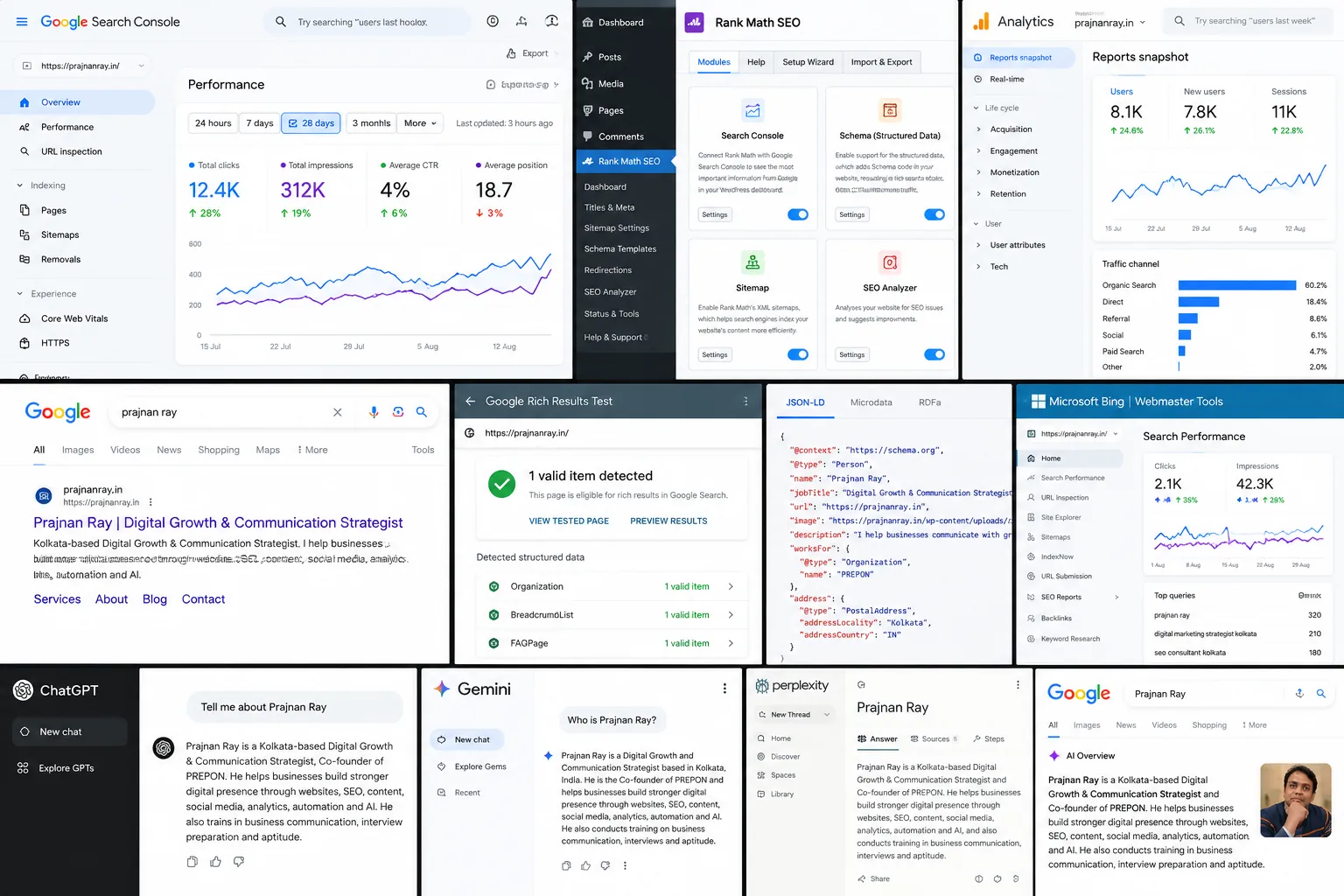
SEO, AEO, GEO, SXO & AI SEARCH · SOLUTION 06
Your potential customers are searching online. Let's make your business more relevant, discoverable and compelling to them.
Appearing in Google search results requires more than having a functioning website. Your business needs to understand what customers search for, provide useful answers, demonstrate its expertise and communicate clearly why its services deserve attention.
We combine keyword research, competitor analysis, technical SEO, content strategy and search-performance measurement to improve your website's relevance and strengthen its opportunities to attract potential customers.
Before optimising your website, we need to understand how potential customers search for your products or services. The right strategy begins with identifying their needs, questions, buying intentions and the language they use when looking for solutions.
Google Keyword Planner, Google Trends and Google Search Console help identify search terms, evaluate search patterns and examine existing search performance. Keyword clustering, search-intent analysis and competitor research help determine which topics are relevant to different stages of the customer journey.
I research relevant keywords, investigate customer search intent and evaluate opportunities based on commercial relevance rather than search volume alone. This helps your business focus on searches that are more likely to attract people genuinely interested in its services.
I examine competitors' search visibility, content coverage and website structures to identify gaps and opportunities. These findings help your website address customer needs your competitors may not be serving adequately.
I organise related keywords into meaningful groups and map them to appropriate service pages, supporting articles and customer questions. Consequently, your website can develop a clearer content structure that connects relevant searches with the right information.
Your SEO strategy should begin with your customers, not a list of popular keywords. I identify the searches that matter to your business and build a practical strategy around them.
Customers may describe their problems differently from the terminology your industry uses. I connect their natural search language with understandable service descriptions, useful explanations and relevant website headings.
Because of this, potential customers can recognise that your business understands their needs, find relevant answers and feel more confident exploring your services.
Once we understand what customers are searching for, your website needs to provide relevant information that answers their questions. Service pages, articles and supporting content should explain your offerings clearly, demonstrate expertise and help visitors decide what to do next.
On-page SEO involves optimising page titles, meta descriptions, heading structures, internal links and relevant content. Rank Math can support selected WordPress SEO configurations, while Google Search Console helps identify pages and queries with opportunities for improvement. Search-intent mapping supports the alignment of content with customer needs.
I optimise service pages, headings, metadata and supporting content around relevant search intent, without unnecessary keyword repetition. This makes your website more useful to potential customers and better aligned with the topics they are searching for.
I develop content briefs and improve existing articles by identifying unanswered questions, outdated information and opportunities to demonstrate genuine expertise. This helps your business publish more purposeful content that addresses real customer concerns.
I strengthen internal linking, content relationships and calls to action so visitors can move naturally from information to relevant services. As a result, your website can guide interested readers towards meaningful business enquiries rather than leaving them at isolated articles.
Your content should do more than contain keywords. I make it useful, understandable and relevant to customers while strengthening the foundations of your organic search strategy.
Search-friendly content should never feel as though it was written for a machine. I use clear, familiar language, organise complex information logically and explain business benefits without flowery expressions or unnecessary jargon.
Because of this, visitors can understand your expertise, find answers more easily and recognise how your services relate to their requirements.
Relevant content is important, but customers also need credible reasons to choose your business. Your website should demonstrate expertise, present accurate business information and make its pages appealing when they appear in search results.
Search Console performance reports help evaluate impressions, clicks, queries and click-through rates. Technical content audits, relevant Schema.org structured data, internal linking and appropriate author or business information can improve content clarity. Backlink analysis and legitimate digital PR opportunities can support broader authority-building efforts.
I evaluate how your pages appear in search results and improve descriptive titles and meta descriptions where appropriate. This can help your business present clearer reasons for relevant searchers to visit your website.
I strengthen evidence of expertise through accurate service information, appropriate professional credentials, useful supporting content and clear business identification. These improvements help potential customers evaluate your credibility and understand why your services may be suitable for them.
I review relevant linking opportunities, content relationships and technical presentation, avoiding artificial link-building practices. This helps establish a more credible, consistent and sustainable foundation for your website's organic visibility.
Being visible is only part of the challenge. I help your business present its expertise convincingly so potential customers have stronger reasons to explore your website.
A business builds confidence when its claims, credentials and core messages are accurate and consistent. I ensure that your website communicates its expertise clearly and maintains dependable messaging across relevant online platforms.
Because of this, potential customers can encounter a recognisable business identity, understand its expertise and make more informed decisions about engaging with you.
SEO requires continuous evaluation. Customer interests change, competitors publish new content and search performance can fluctuate. We need to understand which searches bring relevant visitors to your website, which pages deserve improvement and whether organic traffic contributes to your business objectives.
Google Search Console provides query-level and page-level search data, including impressions, clicks, click-through rates and average positions. Google Analytics 4 helps evaluate organic visitor engagement and measurable conversions. Looker Studio can combine relevant findings into practical reports. Google Trends helps identify changes in search interest.
I monitor search visibility, keyword performance and landing-page trends to identify improvements, declines and emerging opportunities. This allows your business to understand how its organic visibility is developing and where further attention is required.
I connect search performance with visitor engagement, enquiry events and other measurable business outcomes. This helps distinguish relevant customer interest from traffic growth that produces little commercial value.
I regularly evaluate content gaps, underperforming pages, changing customer searches and competitor activity to prioritise updates. Over time, this supports a more responsive SEO strategy based on evidence and meaningful business priorities.
SEO success should be measured by business relevance, not rankings alone. I turn search data into practical improvements that support better discovery, stronger engagement and potential business growth.
SEO reports can be overwhelming when they contain technical measurements without context. I translate search-performance findings into straightforward explanations, connect customer-search behaviour with content decisions and identify the improvements that matter most.
As a consequence, your business can understand its SEO progress, make informed investment decisions and communicate more effectively with customers searching for its services.
For businesses requiring deeper competitive intelligence, specialist platforms such as Semrush, Ahrefs, SE Ranking and Screaming Frog can support detailed keyword-gap analysis, competitor research, backlink evaluation, large-scale technical audits and ongoing search-performance monitoring.
With access to appropriate specialist platforms, I can examine competitor strategies, uncover missed keyword opportunities, investigate content gaps and assess the quality and structure of your website's backlink profile. These findings help your business prioritise valuable SEO opportunities and allocate resources to improvements with stronger commercial potential.
I connect advanced technical findings with practical business decisions, ensuring that additional research supports a clearly defined growth objective.
Let's develop an SEO strategy that connects customer searches with useful content, strengthens your online credibility and creates better opportunities for relevant visitors to find your services.
Ready to make your business more discoverable on Google?
SEO, AEO, GEO, SXO & AI SEARCH · SOLUTION 07
Your customers are discovering businesses through AI-powered search. Let's make yours easier to find, understand and evaluate.
People increasingly use AI-powered search experiences to ask questions, compare services and research businesses. These systems may draw on search indexes, website content and other accessible sources when generating answers.
We combine technical SEO, answer-focused content, structured information and digital credibility strategies to strengthen how clearly your business is represented across relevant online sources.
Before AI-assisted search experiences can use information about your business, that information needs to be accessible, accurate and clearly organised. We need to ensure your website has a sound technical foundation and explains your services in ways that search systems and potential customers can understand.
Google Search Console supports inspection of crawling and indexing. XML sitemaps, internal linking, canonical URLs and appropriate robots directives help manage discovery and access. Schema.org structured data, including JSON-LD, can describe supported business and content entities, while standard HTML and meaningful headings help organise readable information.
I investigate crawling, indexing, content accessibility and technical barriers affecting important pages. This helps your business establish a stronger foundation for its information to be discovered and evaluated by compatible search systems.
I implement relevant structured data, improve internal linking and organise important service and business information. These improvements make your website clearer about what your business does, whom it serves and how its pages relate to one another.
I review access restrictions, page rendering and relevant crawler behaviour without compromising security or privacy requirements. This helps your business make public information more reliably accessible to appropriate discovery systems.
AI discoverability begins with information that can be accessed and understood. I strengthen your website's technical and informational foundations without relying on shortcuts or unsupported visibility promises.
AI search systems and customers both benefit from accurate, well-organised explanations. I use familiar terminology, clear service descriptions and consistent business information rather than vague promotional language or unnecessary technical jargon.
Because of this, your business can present a clearer identity and make it easier for people to understand its services wherever they encounter its information.
Customers often interact with AI-powered search by asking complete questions rather than entering a few keywords. Your content should address those questions directly, provide useful context and demonstrate practical knowledge of the problems your business solves.
Google Search Console, Google Trends, Keyword Planner and relevant question research support the identification of customer interests. Answer Engine Optimisation (AEO) focuses on creating clear, useful answers in appropriate formats. Semantic HTML, logical headings, relevant FAQs, comparison content and concise explanatory sections support understandable content structure.
I research customer questions, related search intentions and recurring information needs across the buying journey. This helps your business develop content around genuine customer concerns instead of chasing isolated keywords.
I organise useful answers, explanations, service comparisons and supporting information into coherent page sections. As a result, visitors can find relevant information quickly and evaluate whether your services meet their requirements.
I improve content clarity, terminology and contextual connections while ensuring that detailed explanations remain accurate and useful. This provides more understandable material that compatible search and AI-assisted systems may use when interpreting relevant topics.
Your content should answer real questions rather than merely target search phrases. I help turn your professional knowledge into understandable, useful information that supports customer discovery.
My background in communication and training helps me anticipate misunderstandings, explain technical subjects in simple language and organise answers in the sequence customers naturally need them.
Because of this, potential customers can understand your expertise, receive relevant explanations and approach your business with greater confidence.
Your website is not always the only source of information about your business. Potential customers may encounter your company through business listings, professional profiles, articles, relevant directories and third-party references. Conflicting or incomplete information can make your identity and expertise harder to understand.
Google Business Profile, relevant professional directories, official social profiles and trustworthy external references can contribute to a business's discoverable online presence. Appropriate Organisation, LocalBusiness, Person and related Schema.org types can clarify supported identity information. Consistent names, service descriptions, contact details and relevant entity relationships support accurate representation.
I review how your business name, services, location, professional identity and contact information appear across relevant public platforms. This helps establish a more accurate and recognisable business presence wherever customers research your services.
I improve consistency between your website, business profiles and appropriate external listings, while validating relevant structured identity information. As a result, your business can reduce contradictory information and communicate its identity more clearly.
I identify opportunities to demonstrate genuine expertise through professional credentials, original insights, case studies and appropriate third-party references. These efforts can help potential customers evaluate your credibility using meaningful evidence rather than unsupported claims.
Credibility is built through accurate information and demonstrated expertise. I help your business communicate a consistent identity across the platforms where customers may encounter it.
I ensure that your core business message remains recognisable while adapting its presentation to the requirements of different platforms. Consistency means retaining the same facts, values and service positioning, not mechanically repeating identical sentences everywhere.
Because of this, customers can recognise your business across platforms, understand its expertise and encounter fewer conflicting messages when comparing their options.
AI-assisted search systems evolve, and their answers may vary depending on the platform, question, available sources and other factors. We need to observe how your business is represented, identify information gaps and improve its online presence based on useful evidence.
Google Search Console and GA4 can help assess relevant search and referral traffic where identifiable. Manual testing of representative questions across ChatGPT, Gemini, Perplexity and other relevant interfaces can provide qualitative observations. Looker Studio can bring selected metrics together, while specialist AI visibility platforms may offer additional monitoring with their own methodological limitations.
I develop representative customer questions and review how relevant AI-powered discovery experiences describe your business, services and competitors. This can help your business identify inaccurate information, missing context and opportunities to improve its public content.
I examine identifiable referral activity, customer enquiries and relevant search data alongside qualitative observations. This enables your business to evaluate available evidence without mistaking occasional AI mentions for proven commercial results.
I prioritise improvements to service explanations, factual accuracy, content coverage and cross-platform information consistency. Over time, this supports a more dependable and useful digital presence as discovery experiences continue to change.
AI visibility is not a guaranteed placement or a single score. I focus on accurate information, useful content and measurable customer opportunities rather than promises of citations or mentions.
I translate emerging AI-search findings into practical language and explain the difference between verified results, observed patterns and assumptions. I also ensure that updates retain clear, consistent messaging for human readers.
As a consequence, your business can make better-informed decisions about AI-search opportunities and communicate its services more effectively across changing discovery platforms.
For businesses requiring more systematic research into AI-assisted discovery, specialist platforms such as Profound, Peec AI and Semrush's AI visibility tools can help examine brand mentions, citations and comparative visibility across supported AI platforms. Their coverage, methodologies and available features vary, and observations should not be treated as exhaustive measures of all AI-generated answers.
I can develop representative prompt sets, evaluate supported platform results, compare relevant competitor mentions and investigate which public sources appear in observed answers. This helps your business identify information gaps, prioritise credible content improvements and evaluate changes in observed AI-search visibility.
I connect specialist research with practical business priorities rather than treating AI visibility metrics as guaranteed predictors of enquiries or revenue.
Let's strengthen your website's technical foundations, answer customer questions clearly and build a consistent digital presence that supports discoverability across search engines and AI-assisted platforms.
Ready to prepare your business for AI-powered discovery?
SEO, AEO, GEO, SXO & AI SEARCH · SOLUTION 08
Your customers are searching for businesses nearby. Let's make yours easier to discover and choose.
When people search for products or services in their area, Google Search and Google Maps can help them discover relevant businesses. If your business information is incomplete, inaccurate or difficult to find, potential customers may overlook your services.
We combine local SEO, Google Business Profile optimisation, location-focused website content and customer communication to strengthen your local digital presence and improve opportunities for relevant enquiries.
Before customers can confidently choose your business, they need accurate information about what you offer, where you operate and how to contact you. Your Google Business Profile and other public business listings should communicate these details clearly and consistently.
Google Business Profile allows eligible businesses to manage information such as business categories, contact details, operating hours, services, photographs and service areas. Google Search and Maps help assess how published information appears, while website and directory reviews identify inconsistencies.
I review your Google Business Profile, business categories, service descriptions, contact details and operating information to identify missing or inaccurate information. This helps customers recognise your business and find reliable information when searching locally.
I optimise applicable business attributes, service listings, photographs and profile information within Google's guidelines. These improvements help potential customers understand what your business offers and determine whether it meets their needs.
I check the consistency of important business information across your website, Google Business Profile and relevant business directories. This helps establish a more recognisable and dependable local business presence.
Local visibility begins with information customers can trust. I make your business easier to identify, understand and contact across relevant local discovery platforms.
Local customers often search using familiar service names and everyday language. I develop clear descriptions that explain what your business offers, whom it serves and where it operates, without unnecessary jargon or exaggerated claims.
Because of this, potential customers can recognise your services, verify important business details and contact you with greater confidence.
Your Google Business Profile is only one part of your local digital presence. Your website also needs to explain your services, demonstrate genuine location relevance and answer questions customers ask when looking for businesses in their area.
Google Keyword Planner, Google Trends and Google Search Console support research into relevant service and location-based searches. On-page SEO, internal linking, Google Maps integration and appropriate LocalBusiness structured data help organise accurate business information. Google Search Central guidance supports technical implementation.
I research location-relevant keywords, service-related questions and genuine local search intent. This helps your website address the needs of customers looking for services in the areas your business actually serves.
I optimise relevant service and location pages, headings, metadata, internal links and business information. As a result, potential customers can find clearer information about your services and their availability in relevant locations.
I implement appropriate business structured data and connect your website with verified business information. These improvements support a clearer and more consistent representation of your business across its website and relevant search systems.
Local SEO should connect real customer needs with accurate service and location information. I help your website communicate where your business operates and why its services are relevant.
I use clear geographical references and familiar customer terminology without artificially repeating city names or creating misleading location pages. The emphasis remains on useful information that reflects your actual business operations.
Because of this, customers can understand where your services are available, whether your business is relevant to them and how to take the next step.
Finding your business is only the beginning. Customers also look for evidence that it is reliable, responsive and capable of meeting their needs. Genuine reviews, accurate photographs, professional responses and consistent information can help them evaluate their options.
Google Business Profile provides review-management and customer-interaction capabilities. Business Profile policies govern review solicitation, incentives and prohibited review manipulation. Authentic business photographs, service details and relevant third-party references can support an accurate public presence.
I assess how your business presents its services, professional identity and customer feedback across relevant public platforms. This helps potential customers evaluate your credibility through accurate and meaningful business information.
I develop appropriate review-request and response processes that encourage genuine customer feedback without incentives, fabricated reviews or review filtering. This supports a more credible public record of customer experiences and professional engagement.
I improve the presentation of authentic photographs, service explanations, business updates and relevant trust signals. These improvements help customers understand your business and make more informed decisions before contacting you.
Local credibility cannot be manufactured through ratings or promotional claims. I help your business present genuine evidence of its capabilities and communicate professionally with customers.
How you respond to feedback matters. I develop courteous, specific and understandable responses that acknowledge customer experiences, address concerns appropriately and maintain a consistent professional tone.
Because of this, prospective customers can gain a clearer understanding of your business, while existing customers receive more thoughtful and consistent communication.
Local search performance changes with customer demand, competition, search relevance and business information. We need to understand how customers discover your business, which services generate interest and where meaningful improvements are possible.
Google Business Profile Performance provides available measurements of profile interactions and discovery. Google Search Console supports analysis of relevant website queries and pages. GA4 can measure website engagement and selected contact actions, while Looker Studio can consolidate relevant reporting data.
I analyse available Business Profile performance indicators, website searches and customer interaction trends to evaluate local discovery. This helps your business understand how potential customers find and engage with its local digital presence.
I configure appropriate tracking for contact actions, enquiry forms and relevant website interactions, where technically supported. This allows your business to evaluate identifiable customer interest rather than relying on search visibility alone.
I identify opportunities to improve business information, service content, customer communication and relevant local landing pages based on observed performance. Over time, this supports more informed decisions about strengthening your local marketing efforts.
Local SEO should help customers discover and engage with your business. I connect search visibility, customer interactions and practical improvements to support meaningful local growth.
I translate local search and customer-interaction reports into straightforward explanations. I identify which messages, service descriptions and customer questions need attention, while distinguishing measurable outcomes from assumptions.
As a consequence, your business can understand its local search performance, refine its communication and make more informed decisions about reaching nearby customers.
For businesses that need deeper analysis of local competition and geographic search visibility, specialist platforms such as BrightLocal, Whitespark and Semrush's local SEO tools can support local ranking research, business-listing audits, competitor comparisons and reputation-monitoring workflows. Their coverage and capabilities vary by location and subscription.
I analyse relevant competitors, investigate local search differences across service areas, review business-listing consistency and evaluate opportunities to strengthen your local digital presence. This helps your business identify geographically relevant opportunities, prioritise worthwhile improvements and make better-informed local SEO investments.
I turn local competitive research into practical decisions that support more accurate business information, stronger customer communication and relevant discovery opportunities.
Let's strengthen your local presence, communicate your services clearly and make it easier for potential customers to discover, evaluate and contact your business through Google Search and Maps.
Ready to make your business easier to find locally?
SEO, AEO, GEO, SXO & AI SEARCH · SOLUTION 09
You're creating videos, but people aren't discovering them. Let's help your content reach the right viewers and give them reasons to keep watching.
Creating useful videos takes time and effort, but publishing them does not automatically bring an audience. Your videos need to address topics people care about, communicate their value clearly and deliver an experience that encourages viewers to continue watching.
We combine YouTube search research, content strategy, video presentation, audience-behaviour analysis and performance optimisation to improve your videos' discoverability and strengthen opportunities for meaningful audience growth.
Before planning more videos, we need to understand who your viewers are, what they search for and which questions or interests bring them to YouTube. Choosing relevant topics helps your content serve a defined audience rather than relying on random uploads.
YouTube Studio Analytics provides information about audience interests and discovery patterns where sufficient data is available. YouTube search suggestions, Google Trends and relevant competitor-channel research help investigate video topics and audience demand. Content-gap analysis can reveal questions or formats that deserve greater attention.
I research relevant video topics, audience questions and search intentions, considering how they connect with your business objectives. This helps your channel focus on subjects that matter to the people you want to reach.
I examine competing and related channels, reviewing successful topics, presentation formats and gaps in their content coverage. These findings help identify opportunities to create more distinctive and relevant videos.
I develop topic clusters, content priorities and practical publishing plans for tutorials, demonstrations, explainers or other appropriate formats. As a result, your channel can build a more coherent content library that encourages viewers to explore related videos.
Your videos should begin with audience needs, not assumptions about what might become popular. I help you choose topics that support relevant discovery and long-term channel development.
My background in communication and training helps me turn broad topics into specific viewer questions and organise explanations around what the audience needs to understand. I avoid unnecessarily complicated terminology and vague, attention-seeking subjects.
Because of this, viewers can recognise the relevance of your topics, understand what they will learn and decide more confidently which videos to watch.
Even a useful video may be overlooked when its title is unclear, its thumbnail fails to communicate the topic or its description provides little context. We need to make each video's purpose easy to recognise without misleading viewers.
YouTube Studio supports video titles, descriptions, thumbnails, subtitles, chapters and other publishing information. YouTube Analytics provides impressions and click-through-rate measurements where available. Search-intent research and thumbnail comparison help inform presentation decisions. YouTube's thumbnail testing features may be useful when available and eligible.
I develop clear, search-relevant video titles that communicate the main subject and a credible reason to watch. This helps potential viewers understand your video's relevance when they encounter it in search or recommendations.
I design and refine thumbnails with readable text, appropriate imagery and a recognisable visual identity. These improvements can make your videos easier to notice, distinguish and evaluate across different screen sizes.
I optimise descriptions, relevant chapters, subtitles and supporting information to provide accurate context and improve navigation. Consequently, viewers can understand the content more easily and find the sections most useful to them.
A strong title and thumbnail should earn attention without creating false expectations. I combine clear communication and visual design to make your videos more compelling to the right audience.
I use familiar words, concise titles and clear visual messages rather than exaggerated claims or confusing technical language. The promise made by a title and thumbnail must match what the video actually delivers.
Because of this, potential viewers can understand what to expect, recognise the video's value and approach your content with greater confidence.
Getting someone to click is only the beginning. Viewers also need a clear introduction, understandable explanations and a logical progression that keeps the content useful. We should improve the viewing experience without adding unnecessary complexity.
YouTube Studio provides audience-retention and engagement information for eligible videos. Retention graphs can help investigate moments where viewers stop watching or revisit content. Video-editing tools such as Adobe Premiere Pro, DaVinci Resolve and Descript can support pacing, captions, audio clarity and structured presentation. Playlists, chapters and end screens can support movement between related videos.
I review video structure, introductions, pacing and audience-retention patterns to identify potential reasons viewers lose interest. This helps improve the clarity and usefulness of the viewing experience.
I refine scripts, transitions, demonstrations, captions and supporting visuals to make information easier to follow. As a result, viewers can understand important points without unnecessary confusion or distractions.
I organise related videos through suitable playlists, end screens and contextual recommendations. This provides viewers with clearer opportunities to explore additional content relevant to their interests.
Viewer engagement depends on delivering the value your content promises. I combine structured storytelling, effective editing and audience insights to make videos more useful and enjoyable to watch.
My teaching and communication experience helps me organise explanations from simple ideas to more detailed information, anticipate viewer questions and maintain a natural conversational flow.
Because of this, viewers can follow your content more comfortably, understand your message and find reasons to explore additional videos.
YouTube growth cannot be understood through views alone. We need to examine how viewers discover your content, whether they choose to watch, how long they remain engaged and which topics contribute to your channel's objectives.
YouTube Studio Analytics provides available measurements such as impressions, click-through rates, watch time, audience retention, traffic sources and returning-viewer behaviour. Google Analytics 4 can help measure relevant visits to your website from YouTube when properly configured. Looker Studio or other reporting tools can consolidate selected information where supported.
I analyse video discovery, impressions, click-through rates and traffic sources to understand how viewers encounter your content. This helps your channel identify which topics and presentation approaches deserve further attention.
I examine audience retention, watch time, viewer engagement and returning-viewer patterns across relevant videos. These findings help identify opportunities to improve content structure, relevance and ongoing audience relationships.
I connect channel performance with suitable business outcomes, such as website visits, relevant enquiries or audience development. Over time, this supports more informed content investment and a clearer understanding of YouTube's contribution to your objectives.
YouTube success should be judged against your audience and business goals, not isolated view counts. I turn channel analytics into practical improvements that support relevant discovery and sustainable development.
I translate channel measurements into understandable recommendations and explain how changes in topics, titles, thumbnails and presentation may influence viewer behaviour without confusing correlation with proof.
As a consequence, your business can understand its video performance, refine its messages and make better-informed decisions about future content.
For channels requiring deeper topic research and competitive analysis, specialist platforms such as vidIQ, TubeBuddy and Google Trends can provide additional keyword research, topic exploration, competitor comparisons and video optimisation insights. Their features, data sources and subscription requirements vary.
With access to suitable research platforms, I can investigate topic opportunities, assess competing video presentations, develop keyword-informed content plans and identify possible improvements to titles and publishing strategies. This helps your channel prioritise relevant topics, differentiate its content and make better-informed decisions about video discoverability.
I connect specialist research with your actual audience, channel performance and business objectives rather than treating third-party optimisation scores as guarantees of visibility or growth.
Let's develop a YouTube strategy that connects your videos with the right audience, improves how your content is presented and turns performance insights into better videos and stronger opportunities for growth.
Ready to help more relevant viewers discover your videos?
SEO, AEO, GEO, SXO & AI SEARCH · SOLUTION 10
You're investing in SEO. Let's find out whether it's attracting the right customers and contributing to your business growth.
More impressions, higher rankings and increased website traffic may look encouraging, but they don't necessarily mean that your business is gaining customers. You need to understand whether people discovering your website are genuinely interested in your services and whether their visits lead to meaningful actions.
We combine search analytics, conversion tracking, business reporting and strategic analysis to connect SEO performance with your commercial objectives and identify where your investment can deliver greater value.
Before deciding whether your SEO strategy is working, we need to establish how customers discover your website. Which searches generate impressions? Which pages attract clicks? Are you becoming more visible for searches relevant to your business?
Google Search Console provides information about search queries, impressions, clicks, click-through rates and average positions. Google Analytics 4 helps examine organic landing pages and visitor engagement. Google Trends provides context about changes in search interest, while Looker Studio can consolidate selected findings into reports.
I audit your organic search performance, examining relevant queries, landing pages, visibility trends and changes over time. This helps your business understand where its website is gaining or losing relevant search exposure.
I distinguish commercially relevant searches from broad informational queries that may generate impressions without attracting suitable customers. Consequently, your business can focus on visibility that is more closely connected to its actual services and target audience.
I establish meaningful reporting periods and performance baselines while considering seasonality, demand changes and differences between branded and non-branded searches. This allows you to evaluate progress in context rather than relying on isolated numbers.
A higher ranking or more impressions isn't automatically business growth. I investigate what your search performance actually means and where it creates opportunities for your business.
SEO reports often contain measurements that are difficult to interpret without context. I explain what impressions, clicks, positions and search trends mean in straightforward language and connect them to your business objectives.
Because of this, you can understand where your website is gaining attention, whether that attention is relevant and which search opportunities deserve closer examination.
Attracting visitors is useful only when their actions support your objectives. We need to understand what happens after someone reaches your website through Google and whether their visit leads to an enquiry, booking, purchase or another meaningful business interaction.
Google Analytics 4 supports measurement of relevant website events and key events. Google Tag Manager helps manage applicable tracking implementations, including form submissions, telephone clicks and WhatsApp interactions. WooCommerce can provide purchase and order data where relevant. Consent configuration, event validation and appropriate attribution reporting are important for reliable analysis.
I configure and validate relevant enquiry and conversion events, including form submissions, click-to-call interactions, WhatsApp clicks and purchases where applicable. This gives your business better visibility into the meaningful actions visitors take after reaching your website.
I analyse organic traffic sources, landing pages and conversion pathways to identify which areas contribute to measurable customer interest. These findings help you recognise which services and pages generate valuable interactions rather than traffic alone.
I compare tracked enquiry activity with available business records and investigate measurement gaps, attribution limitations and incomplete journeys. This helps your business develop a more reliable understanding of SEO's contribution to actual commercial opportunities.
Your website should attract more than attention. I connect organic search activity with measurable customer actions so you can better understand the business value of your SEO investment.
A click on a contact button is not necessarily a qualified enquiry, and an enquiry is not automatically a customer. I explain these differences clearly and connect technical measurements with the real decisions customers make.
Because of this, you can distinguish website activity from meaningful customer interest and evaluate your SEO performance with greater confidence.
Search performance, website traffic, enquiries and sales information often sit in separate systems. Without bringing them together, it's difficult to understand the complete picture or identify where your marketing efforts are producing value.
Looker Studio can combine supported information from Google Search Console, GA4 and compatible data sources into interactive reports. Google Sheets supports structured analysis, while BigQuery and Google Cloud can support larger datasets and more complex reporting requirements. Data-source compatibility, permissions and measurement definitions must be validated.
I combine relevant search, traffic, engagement and conversion information into understandable dashboards and reports. This helps your business see important performance indicators together instead of switching between disconnected platforms.
I organise reporting around meaningful business questions, such as which services attract qualified interest, which pages underperform and how organic traffic contributes to enquiries. This allows you to identify useful opportunities and make decisions based on evidence rather than disconnected statistics.
I establish suitable performance indicators, reporting definitions and comparison periods, documenting important data limitations where necessary. These measures help your business track progress more consistently and avoid drawing misleading conclusions from incomplete information.
Reports should help you make decisions, not merely display charts. I turn search and website data into understandable insights that support practical business improvements.
My experience in communication and training helps me explain complex measurements using familiar language, logical comparisons and clear conclusions. I connect technical findings with the decisions they can support rather than overwhelming clients with unnecessary metrics.
As a consequence, you can understand what's working, recognise areas that need attention and communicate marketing priorities more confidently within your business.
Once we understand which searches, pages and customer journeys contribute to meaningful outcomes, we need to act on those findings. SEO investment should be guided by evidence, business priorities and opportunities for sustainable improvement.
Google Search Console and GA4 support analysis of search performance, organic engagement and measured conversions. Looker Studio helps compare reporting periods, while relevant content audits, search-intent analysis and controlled website experiments can support the evaluation of specific improvements. Revenue attribution and return-on-investment calculations require trustworthy cost and business outcome data.
I identify pages that attract relevant visitors but generate limited engagement or enquiries, then investigate opportunities to improve their content and conversion pathways. This helps your website make better use of the attention it already receives.
I compare SEO opportunities according to customer relevance, commercial potential, implementation effort and available performance evidence. Consequently, your business can prioritise improvements that are more closely aligned with its growth objectives.
I evaluate the effects of content updates, technical changes and conversion improvements over suitable reporting periods, recognising external factors and measurement limitations. Over time, this supports a more focused and accountable SEO strategy built around observable results.
SEO should be an investment with clear objectives, not an ongoing expense without direction. I connect performance evidence with practical decisions that support relevant enquiries and sustainable business opportunities.
I translate findings into clear recommendations, explain the reasons behind proposed changes and ensure the benefits and limitations are understandable. I also refine customer-facing content based on what search and engagement data reveal about audience needs.
As a consequence, your business can make more informed SEO investment decisions, communicate more effectively with potential customers and focus resources on meaningful improvements.
For businesses requiring deeper competitive benchmarking, SEO forecasting and business intelligence, specialist platforms such as Semrush, Ahrefs and SE Ranking can provide additional keyword and competitor performance information. Google BigQuery, Google Cloud and advanced Looker Studio reporting integrations can support more detailed analysis of search, marketing and business data when sufficient information and technical resources are available.
I can investigate competitor visibility, evaluate keyword opportunities, integrate compatible datasets and develop more detailed reporting models using available cost, conversion and business outcome information. This helps your business understand its competitive position, assess potential opportunities and allocate SEO resources more effectively.
I connect advanced analysis with practical business decisions while clearly distinguishing verified outcomes, estimates and assumptions.
Let's connect your search performance with customer enquiries, meaningful engagement and business objectives, so you can understand what's working, identify opportunities and make smarter marketing decisions.
Ready to understand the real value of your SEO efforts?
SERVICE 03 / 06
Give your brand a clear, recognisable visual identity and communicate with purpose. I develop consistent graphic systems, design marketing creatives, improve photographs, edit videos and structure visual stories around what customers need to understand. The goal is professional, accessible content that carries the right message across your website, social platforms and campaigns.

GRAPHIC DESIGN & VIDEO EDITING · SOLUTION 11
Your business deserves a recognisable visual identity. Let's make every design communicate who you are and why customers should choose you.
Your website, social media posts, advertisements, presentations and promotional materials should feel like they belong to the same business. Inconsistent colours, typography, imagery and messaging can make your brand harder to recognise and your communication less effective.
We combine brand strategy, graphic design, visual communication and customer understanding to create professional designs that strengthen brand recognition, explain your offerings clearly and support your marketing objectives.
Before creating individual graphics, we need to define how your brand should look and what it should communicate. Your colours, typography, logo usage, imagery and visual style should reflect your business identity and remain recognisable across different platforms.
Adobe Illustrator and Adobe Photoshop support logo refinement, vector graphics, brand assets and visual identity development. Colour systems, typography standards, logo variations, spacing rules and brand-style guides help establish consistent design practices across websites, social media, presentations and printed materials.
I evaluate your existing logo, colours, typography, imagery and marketing materials to identify inconsistencies and opportunities for improvement. This helps your business establish a clearer visual identity that customers can recognise across different platforms.
I develop or refine appropriate brand elements, including colour palettes, typography systems, graphic styles and logo-usage guidelines. These decisions create a more professional and consistent appearance for your business communications.
I establish reusable visual standards and design templates for common marketing requirements. As a result, your business can maintain a recognisable identity while producing new content more efficiently.
Your brand should be recognisable wherever customers encounter it. I create the visual foundations that make your business look consistent, credible and professionally presented.
Visual identity is not simply about choosing attractive colours and fonts. I connect your brand's visual presentation with its positioning, audience and core message so that design decisions support what your business wants customers to understand.
Because of this, potential customers can recognise your business more easily, understand its positioning and encounter a consistent brand experience across different channels.
Different marketing activities require different kinds of visual communication. A social media post, promotional advertisement, presentation, brochure and website graphic should each serve a clear purpose while remaining consistent with your brand.
Adobe Photoshop and Illustrator support image editing, compositing, typography, vector illustration and the development of graphics for digital and print applications. Appropriate dimensions, export formats, resolution, colour profiles and platform specifications help prepare assets for their intended use.
I design branded social media posts, promotional creatives, digital advertisements, banners, brochures and presentation graphics around specific communication objectives. This helps your business present its products, services and offers professionally across relevant marketing channels.
I develop clear visual hierarchies using suitable typography, imagery, spacing and contrast to guide attention towards important information. Consequently, customers can identify key messages, understand offers and recognise relevant calls to action more easily.
I prepare and adapt design assets for different platforms, screen sizes and production requirements without compromising brand consistency. This allows your business to reuse important campaign messages across formats while maintaining an appropriate visual presentation.
Every marketing graphic should have a purpose beyond looking attractive. I design visuals that communicate clearly, strengthen your brand and support meaningful customer actions.
My communication and training experience helps me distinguish essential information from unnecessary detail. I use concise headlines, familiar language and logical content hierarchy rather than overcrowding designs with decorative text.
Because of this, customers can understand your message quickly, recognise the intended action and respond with greater confidence.
An attractive design can still fail when text is difficult to read, important information is hidden or too many elements compete for attention. Your graphics should remain understandable across mobile screens, desktop displays and relevant printed formats.
Adobe Photoshop and Illustrator support layout refinement, typography, image correction and visual asset preparation. Contrast assessment, responsive image sizing, legibility checks, visual hierarchy principles and accessibility guidance help evaluate design effectiveness. Platform previews and appropriate export testing reveal presentation differences.
I review visual hierarchy, font sizes, colour contrast, image quality and content density to identify elements that may obstruct understanding. This helps your audience read important information more comfortably and recognise the message without unnecessary effort.
I refine layouts, spacing, typography and graphical elements to establish a clearer relationship between headlines, supporting information and calls to action. These improvements make your designs easier to scan, more balanced and better suited to their intended purpose.
I adapt graphics for relevant devices and platforms, checking text legibility, cropping, safe areas and appropriate output quality. As a result, your business can communicate more consistently without losing important information across formats.
Effective design should reduce confusion, not create it. I make visual communication clearer, more accessible and easier for customers to understand.
I focus on what the audience needs to notice first, what they need to understand next and which action they should take. Simple words, meaningful headings and well-structured information take priority over flowery language or unnecessary decoration.
Because of this, your audience can find relevant information faster, understand your message more easily and interact with your brand with fewer distractions.
As your business grows, you may need graphics for multiple campaigns, platforms, products and services. Creating every asset independently can waste time and lead to inconsistent results. A structured design process helps maintain quality while supporting regular content production.
Adobe Creative Cloud applications, reusable templates, vector asset libraries, shared design specifications and organised project files support repeatable production workflows. Version control, naming conventions, export presets and quality-assurance checks help maintain consistency across marketing assets.
I develop reusable design templates, brand elements and campaign layouts suited to your recurring marketing requirements. This helps your business produce consistent content without rebuilding every design from the beginning.
I organise source files, assets and output formats into a practical design workflow, retaining editable masters for future adaptation. These processes make it easier to update offers, create variations and maintain design continuity across campaigns.
I review completed assets for consistency, legibility, accuracy and suitability before their intended use. This helps your business reduce avoidable design errors and maintain a more dependable standard of marketing communication.
Your design process should grow with your business. I create consistent, reusable visual systems that support efficient production without compromising clarity or professional quality.
Consistent communication requires more than repeating a logo and colour palette. I establish message hierarchies, headline styles and content guidelines that allow different campaigns to retain a recognisable brand voice while addressing specific audience needs.
As a consequence, your business can communicate more consistently, develop new marketing materials efficiently and maintain a stronger brand identity over time.
For businesses undertaking a significant brand-development or redesign project, deeper visual research can include structured competitor-brand audits, customer perception studies, audience interviews and design-preference testing. Platforms such as UserTesting, Maze and Typeform can support relevant research activities, depending on the scope, available participants and subscription requirements. AI-assisted design and logo exploration can additionally involve Midjourney for visual concepts, Adobe Firefly for generative imagery and asset refinement, ChatGPT Images for creative exploration, Ideogram for typography-led concepts and Recraft for vector-style graphics and illustrations. These tools support exploration, not automatic acceptance of generated logos or brand assets; originality, licence terms, intellectual-property considerations and suitability for commercial use must be checked.
I use suitable AI-assisted creative tools to investigate alternative visual concepts, illustration styles, typography directions and logo ideas, selecting only concepts that align with your positioning and customer expectations. This helps your business explore distinctive creative directions while keeping brand relevance and communication clarity central to the design process.
I refine promising concepts using professional design judgement and appropriate editing tools, checking legibility, visual consistency and applicability across websites, social media and other business materials. As a result, your business can develop more coherent and practical brand assets rather than relying on unedited AI-generated outputs.
I review originality, applicable usage permissions and potential intellectual-property issues before recommending any AI-assisted material for publication or commercial branding. Consequently, your business can experiment with emerging creative technologies while maintaining stronger control over its identity and reputational risks.
I analyse relevant competitor visual identities, examine audience preferences, test alternative design directions and connect research findings with the business's positioning and communication objectives. This helps your business make more informed design decisions, identify meaningful opportunities for differentiation and invest in a visual identity aligned with customer expectations.
I use design research to support strategic decisions rather than relying solely on personal taste or short-lived visual trends.
Let's create a consistent visual identity and purposeful marketing designs that help customers recognise your business, understand your offerings and engage with your brand more confidently.
Ready to build a stronger and more consistent visual presence?
GRAPHIC DESIGN & VIDEO EDITING · SOLUTION 12
You have photographs, footage and ideas. Let's turn them into professional visuals that communicate your business story.
Poor lighting, distracting backgrounds, unclear audio and unstructured editing can make even valuable content difficult to watch or understand. Your photographs and videos should present your business professionally, explain your offerings clearly and hold your audience's attention.
We combine visual planning, photography enhancement, professional video editing, motion graphics and communication strategy to transform existing materials or new ideas into purposeful content for websites, social media, advertisements and presentations.
Before editing photographs or producing videos, we need to understand their purpose. Who will see them? What should the audience understand? Where will the content be published? These decisions determine the visual style, message, format and production approach.
Creative briefs, storyboards, shot lists and production schedules help organise visual projects. Adobe Photoshop and Illustrator support visual references and storyboarding. Platform specifications for YouTube, Instagram, Facebook, LinkedIn and websites help determine aspect ratios, resolutions and suitable content formats.
I analyse your business objectives, target audience and available visual materials to determine the purpose and priorities of each project. This helps your business invest in photographs and videos that support specific communication and marketing objectives.
I develop content outlines, shot sequences, storyboards and production plans that connect your message with suitable visual storytelling techniques. This creates a clearer production direction and reduces unnecessary revisions or disconnected content.
I plan relevant formats, durations, visual compositions and delivery requirements for the platforms where your content will appear. As a result, your business can create assets suited to their intended audiences and publishing environments.
Professional visual content starts with understanding its purpose. I plan photographs and videos around your audience, message and business objectives rather than producing attractive visuals without direction.
My communication and training experience helps me structure ideas logically, identify what the audience needs to understand and develop clear scripts and explanations. I focus on purposeful information rather than unnecessary complexity or promotional exaggeration.
Because of this, your audience can understand the purpose of your content, follow the message naturally and recognise how it relates to their needs.
Your photographs may contain the right subject but still suffer from poor exposure, distracting backgrounds, unsuitable colours or inconsistent presentation. We need to improve their quality while preserving authenticity and ensuring they serve their intended purpose.
Adobe Photoshop supports exposure correction, colour adjustment, retouching, compositing, background refinement and image preparation. Camera Raw supports tonal and colour adjustments. Adobe Illustrator can create complementary vector illustrations and graphic elements. Appropriate resolutions, compression and export formats help prepare images for websites, advertising and digital platforms.
I correct exposure, lighting, colour balance, contrast and composition to improve photographs while respecting the original subject and context. This helps your business present products, people and services through clearer, more professional imagery.
I remove or reduce distracting visual elements, refine backgrounds and prepare suitable compositions for different marketing applications. These improvements allow customers to focus more easily on the information and subjects that matter.
I develop consistent image treatments, branded compositions and correctly sized assets for websites, social media and promotional materials. Consequently, your business can maintain a coherent visual presentation across multiple communication channels.
Your photographs should reinforce the credibility of your business. I improve their visual quality and presentation without making unnecessary alterations that misrepresent the subjects or services.
An image should support a clear message rather than leave viewers guessing about its significance. I align photographs with suitable headlines, captions and supporting information so visual and written communication work together.
Because of this, potential customers can understand what your images represent, recognise relevant details and evaluate your offerings with greater confidence.
Raw footage rarely communicates a complete story on its own. Unnecessary pauses, confusing sequences, poor audio, inconsistent colours and distracting transitions can weaken the viewing experience. Your videos need a clear structure and polished presentation that supports their message.
Adobe Premiere Pro and DaVinci Resolve support video editing, timeline management, transitions, colour correction and audio synchronisation. Adobe After Effects supports motion graphics, titles, animations and compositing. Descript can assist with transcript-based editing, caption generation and spoken-content workflows. Audio tools support noise reduction, level balancing and sound refinement.
I organise raw footage, select relevant sequences and develop clear opening, middle and closing sections appropriate to the video's purpose. This helps viewers follow the content naturally and understand its central message without unnecessary distractions.
I refine pacing, transitions, colour, exposure, audio clarity, subtitles and supporting visuals using professional editing applications. These improvements create a more consistent, accessible and comfortable viewing experience.
I develop suitable title animations, lower thirds, explanatory graphics, demonstrations and visual emphasis where they genuinely improve understanding. As a result, your videos can communicate important information more effectively and maintain a professional presentation.
Good editing should make the message clearer, not distract from it. I combine technical refinement with purposeful storytelling to produce videos that are easier to understand and more engaging to watch.
My teaching and communication experience helps me recognise unnecessary explanations, organise information in a logical sequence and refine scripts for clarity. I use straightforward language, meaningful examples and natural transitions to make content understandable.
Because of this, viewers can follow your explanations, retain important information and recognise the value your business provides.
A professionally edited photograph or video must also be suitable for its destination. Incorrect dimensions, poor compression, cropped text or unsuitable pacing can reduce its effectiveness. We need to prepare content for different platforms and learn from audience responses.
Adobe Media Encoder, Premiere Pro and DaVinci Resolve support export settings and video compression. Photoshop supports image optimisation and platform-specific dimensions. YouTube Studio, Meta Business Suite, Facebook and Instagram Insights and LinkedIn Analytics provide relevant publishing and performance information. GA4 can help measure associated website interactions where tracking is configured.
I prepare photographs and videos in appropriate aspect ratios, resolutions, formats and compression settings for different publishing platforms. This helps your business maintain better visual quality and reduce avoidable presentation problems across devices.
I develop platform-appropriate thumbnails, captions, supporting graphics and content variations while retaining a consistent brand identity. These changes can make your content easier to recognise, understand and engage with across different channels.
I examine available audience engagement, viewing behaviour and relevant marketing outcomes to identify opportunities for improvement. Over time, these findings can help your business refine future content and use its visual production resources more effectively.
Your visual content should remain effective beyond the editing timeline. I prepare it for real publishing environments and use performance insights to guide future improvements.
Different platforms require different levels of detail and presentation styles, but your central business message should remain consistent. I adapt captions, supporting explanations and calls to action to the audience and context without changing the underlying message.
As a consequence, customers can encounter clearer and more consistent communication across platforms, while your business can make better-informed decisions about future content.
For projects requiring advanced visual effects, AI-assisted production or more complex post-production, specialist platforms such as Runway, Adobe Firefly, Luma AI, Kling AI, Topaz Video AI and ElevenLabs can support selected video-generation, animation, enhancement and voice-production workflows, subject to available features and licensing.
Adobe After Effects, Premiere Pro and DaVinci Resolve provide professional tools for integrating, refining and finishing these materials.
AI-generated content requires additional checks for accuracy, visual consistency, consent, intellectual-property rights and suitability for commercial publication.
I explore AI-assisted video concepts, animation, motion graphics and visual effects where these capabilities are relevant to your campaign or production requirements. This helps your business develop more varied creative concepts and evaluate production approaches that may otherwise require greater time or resources.
I combine suitable AI-generated elements with professional editing, compositing, colour correction, audio refinement and visual-quality checks. As a result, your business can turn experimental creative material into more coherent, polished and platform-ready visual content.
I assess applicable commercial-use rights, permissions and risks of misleading representations before recommending publication. This helps your business make more informed production decisions and reduce avoidable reputational and intellectual-property risks.
AI can extend production capabilities, but compelling videos still depend on clear communication, sound creative judgement and professional post-production. I combine emerging technologies with hands-on editing expertise to produce content that serves your business objectives.
Let's turn your existing footage, photographs and creative ideas into polished visual content that explains your offerings clearly, captures relevant attention and strengthens your brand across digital platforms.
Ready to transform your photographs and videos into professional business content?
GRAPHIC DESIGN & VIDEO EDITING · SOLUTION 13
Your visuals are attracting attention. Let's make sure people understand your message and know what to do next.
Attractive graphics and videos may catch someone's eye, but they cannot achieve much if the message remains unclear. Your audience needs to understand what you're offering, why it matters to them and what action they should take.
We combine visual storytelling, communication strategy, instructional design and creative production to turn complex ideas into clear, engaging messages that connect with your audience and support your business objectives.
Before designing a graphic or producing a video, we need to identify its central message. Who is the audience? What problem are we addressing? What should viewers understand, remember or do after seeing the content? These questions help us separate important information from unnecessary detail.
Audience research, creative briefs, message mapping and customer-journey analysis help identify communication objectives. Google Trends, audience insights and relevant platform analytics can provide additional context about customer interests. Storyboarding and content outlines help translate the findings into a structured visual communication plan.
I analyse your audience, business objectives and existing communication to identify the central message each graphic or video should convey. This helps your business focus its content on information that is relevant to the people it wants to reach.
I distinguish essential facts, customer benefits and supporting details, developing a clear message hierarchy before visual production begins. This allows viewers to recognise the main idea without struggling through unnecessary information.
I connect the message with an appropriate audience need, value proposition and intended action. Consequently, your business can develop purposeful visual content that supports understanding and meaningful engagement.
A powerful visual message begins with knowing what needs to be communicated. I help your business identify the right message before deciding how to present it.
My experience in communication and training helps me identify the gap between what a business wants to explain and what its audience actually needs to know. I replace complicated terminology, vague statements and flowery language with straightforward explanations.
Because of this, your audience can understand the central message more quickly, recognise its relevance and identify what matters to them.
Some products, services and business ideas are difficult to explain through a single headline or image. We need to organise information into a logical sequence, use appropriate examples and choose visual formats that make complex subjects easier to understand.
Storyboarding, scripting, information design, instructional design and visual sequencing help organise complex messages. Adobe Illustrator and Photoshop support diagrams, illustrations and explanatory graphics. Adobe After Effects, Premiere Pro and DaVinci Resolve support animated explanations, transitions and structured video presentations.
I break complicated ideas into understandable stages, identifying the relationships, comparisons and explanations that matter most. This helps customers follow complex information without becoming overwhelmed by unnecessary detail.
I develop visual narratives using relevant examples, illustrations, diagrams, demonstrations and supporting text. These elements make your message easier to understand and more closely connected to real customer situations.
I organise the sequence of information so each section prepares the audience for the next, with a clear conclusion and suitable action. As a result, viewers can follow the story naturally and understand how your offering addresses their needs.
Complex information doesn't need complicated communication. I turn detailed ideas into structured visual stories that people can follow, understand and use.
My teaching experience helps me apply a progression from familiar concepts to more detailed explanations. I anticipate common misunderstandings, select meaningful examples and explain each idea before introducing additional complexity.
Because of this, your audience can understand unfamiliar concepts more comfortably, remember the important ideas and evaluate your services with greater confidence.
A graphic or video can become confusing when its headline says one thing, its imagery suggests another and its narration introduces unrelated information. Every creative element should support the same central message rather than compete for attention.
Adobe Photoshop, Illustrator, After Effects, Premiere Pro and DaVinci Resolve support coordinated production of typography, imagery, motion graphics and video. Descript can assist with transcript-based editing, subtitles and spoken-content refinement. Visual hierarchy, pacing, readability, audio clarity and accessibility checks help improve the final presentation.
I align headlines, scripts, visual elements and supporting information with a clearly defined communication objective. This helps your audience receive a consistent message rather than conflicting visual and verbal signals.
I refine typography, composition, scene transitions, narration, captions and timing so the most important information receives appropriate emphasis. These improvements make the content easier to follow, more comfortable to consume and clearer across different viewing environments.
I remove unnecessary visual effects, repetitive explanations and distracting elements that do not contribute to the message. Consequently, viewers can focus on the information that matters and understand the intended action more easily.
Good visual storytelling isn't about adding more effects. I bring words, images, sound and motion together to communicate one purposeful message.
I pay particular attention to how written, spoken and visual information work together. I prefer simple wording, natural narration and meaningful visual emphasis rather than decorative language or effects that distract from the content.
Because of this, viewers can understand your message through a more coherent experience, with fewer distractions and less effort.
Creating attractive content is not enough. We need to understand whether people recognise the intended message, engage with the information and take relevant action. Their responses can help improve future graphics, videos and communication campaigns.
YouTube Studio, Meta Business Suite, Facebook and Instagram Insights and LinkedIn Analytics provide available engagement and audience-behaviour measurements. GA4 can help measure relevant website interactions after visitors follow a content link. Structured audience feedback, usability testing and appropriate message-comprehension checks can provide additional qualitative evidence.
I examine available audience-engagement data, viewing behaviour and interactions to identify how different visual messages perform. This helps your business recognise which content approaches attract relevant attention and where communication may need improvement.
I review audience feedback, common questions and observable signs of misunderstanding, using direct comprehension testing where appropriate. These findings provide more useful evidence about whether customers understand the intended message.
I refine headlines, storytelling structures, visual presentation and calls to action based on the available evidence. Over time, this supports clearer communication and more informed decisions about future creative content.
Effective creative work should help people understand and respond, not merely generate views. I connect visual communication with audience feedback and practical business objectives.
My communication and training experience helps me distinguish attention from understanding. I use audience questions, comprehension feedback and behavioural evidence to refine explanations without assuming that likes or views prove the message was understood.
As a consequence, your business can identify communication gaps, develop clearer messages and make better-informed creative decisions that support meaningful engagement.
For businesses requiring deeper evaluation of creative communication, specialist platforms such as UserTesting, Maze and Typeform can support structured audience feedback, message-comprehension studies and comparisons between alternative visual presentations. Tools such as Hotjar and Microsoft Clarity can provide additional behavioural context when visual content is embedded within website experiences.
AI-assisted creative platforms such as Midjourney, Adobe Firefly, ChatGPT Images, Ideogram and Runway can also support alternative visual concepts and experimental storytelling treatments, subject to suitability and commercial-use requirements.
I develop and compare alternative storytelling approaches, gather relevant audience feedback and examine whether viewers understand the central message. This helps your business identify communication gaps, evaluate promising creative directions and choose presentations that are easier for customers to understand.
I use suitable AI-assisted tools to explore visual concepts, illustration styles and alternative narrative treatments before refining selected ideas through professional design and editing. As a result, your business can invest in creative directions that combine originality, clarity and consistency with its brand identity.
I evaluate feedback quality, sample limitations, factual accuracy and relevant intellectual-property requirements before recommending final materials. This allows your business to make more informed creative decisions without relying on unsupported assumptions about audience preferences.
Effective storytelling combines creative thinking with evidence and sound communication principles. I use specialist research and emerging technologies to improve how clearly your business connects with its audience.
Let's transform your ideas into clear, purposeful visual stories that explain your offerings, build customer confidence and encourage meaningful engagement with your business.
Ready to make your visual communication clearer and more effective?
SERVICE 04 / 06
Social media should connect with the right people and create genuine business opportunities. I research audiences, plan platform-specific content, develop paid campaigns, measure advertising results and strengthen engagement and lead-generation pathways. Consistent messaging, relevant creative work and meaningful performance evidence guide the strategy.
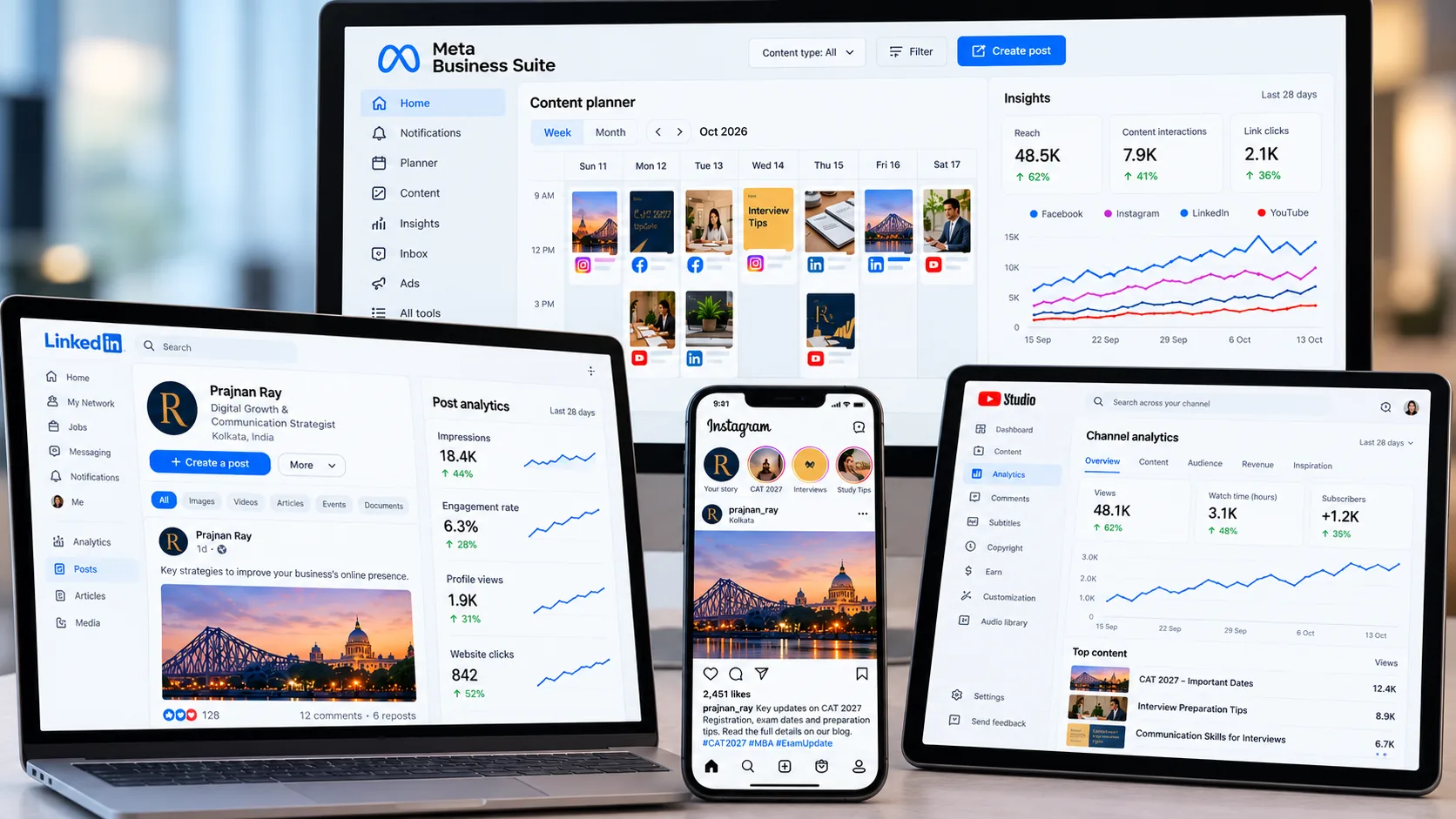
SOCIAL MEDIA MARKETING · SOLUTION 14
You're investing time in social media. Let's make sure you're reaching the right audience with content that matters to them.
Posting regularly does not automatically build an audience or generate business opportunities. Your content needs to reach people who may genuinely benefit from your services, address their interests and give them meaningful reasons to engage with your business.
We combine audience research, platform selection, content strategy, competitor analysis and communication planning to develop a social media presence aligned with your business objectives.
Before investing time and resources in social media, we need to understand who your potential customers are, where they spend their time and what influences their decisions. Your business does not need to be equally active on every platform. It needs to be present where meaningful customer relationships can develop.
Meta Business Suite, Facebook and Instagram Insights, LinkedIn Analytics and YouTube Studio provide available information about audience characteristics, engagement and content performance. Google Trends, competitor research and customer interviews can provide additional context about audience interests and behaviour.
I analyse your business objectives, target customers, existing audience and service offerings to identify the platforms most relevant to your commercial goals. This helps your business focus its resources on channels with stronger potential to reach suitable customers.
I examine audience demographics, interests, content preferences and relevant competitor activity to identify meaningful communication opportunities. These findings help your business understand what its intended audience values and which types of content may attract their attention.
I develop platform priorities, audience segments and practical objectives for awareness, engagement, website visits and enquiries. As a result, your social media activities can follow a more focused strategy rather than relying on disconnected posting decisions.
Your business doesn't need to be everywhere. I help you identify where your customers are most likely to engage and develop a strategy around those opportunities.
Different audiences have different levels of familiarity with your services. I adapt your message to their needs, questions and expectations while retaining a consistent business identity across the selected platforms.
Because of this, potential customers can encounter relevant information, understand your business more easily and recognise why your services may matter to them.
Once we know whom to reach, we need to decide what to communicate. Your content should answer questions, demonstrate expertise, explain services and create opportunities for relevant conversations rather than simply filling a publishing calendar.
Meta Business Suite, LinkedIn Analytics, YouTube Studio, Google Trends and existing website-search data can help identify audience interests, engagement patterns and recurring questions. Content pillars, audience-intent mapping and editorial calendars provide a structured approach to planning posts, carousels, videos and educational content.
I identify content themes based on customer problems, relevant questions, service benefits and your business's expertise. This helps you develop posts that address genuine audience interests instead of publishing unrelated material.
I plan suitable content formats, including informational posts, carousels, short videos, demonstrations and service explanations. This gives your business more effective ways to explain its offerings and connect with different audience preferences.
I develop practical content calendars with clear objectives, publishing priorities and relevant campaign themes. Consequently, your business can maintain a more consistent content presence without relying on last-minute ideas.
A useful content strategy begins with your customers' questions. I turn those questions into a structured communication plan that supports your brand and business objectives.
My experience in training and communication helps me simplify difficult topics, organise explanations logically and communicate benefits using familiar language rather than unnecessary jargon or exaggerated claims.
Because of this, your audience can understand your posts more easily, find answers to relevant questions and develop greater confidence in your expertise.
The same post may not work equally well on Facebook, Instagram, LinkedIn and YouTube. People use these platforms differently, and each offers different ways to discover and engage with content. We need to adapt your presentation while maintaining a consistent brand message.
Meta Business Suite supports Facebook and Instagram publishing and management. LinkedIn's publishing tools and analytics provide relevant professional-audience information, while YouTube Studio supports video publishing and channel insights. Platform specifications, post scheduling, creative testing and content-format analysis help inform publishing decisions.
I adapt headlines, captions, visuals and content formats for the intended audience and context of each platform. This helps your business communicate more effectively without losing its core brand identity.
I develop practical publishing schedules based on available audience activity, campaign requirements and observed performance rather than generic posting-frequency rules. This allows your business to maintain a manageable presence while testing when and how its audience responds.
I coordinate relevant creative assets, descriptions, calls to action and links across platforms, maintaining message consistency. As a result, your audience can recognise your brand and move more naturally towards the information or services that interest them.
Consistent branding doesn't mean posting identical content everywhere. I adapt your communication to each platform while keeping your message recognisable and purposeful.
I consider how people read, watch and interact on each platform. Professional explanations, conversational captions, concise visual messages and appropriate calls to action should all serve the audience without contradicting your brand positioning.
Because of this, customers can receive a clear, consistent message in a format that suits the platform they use.
Social media performance should not be judged by likes or follower counts alone. We need to understand which content reaches relevant people, encourages meaningful interaction and contributes to your business objectives.
Meta Business Suite, Facebook and Instagram Insights, LinkedIn Analytics and YouTube Studio provide platform-specific performance data. GA4, UTM-tagged links and Google Tag Manager can help examine attributable website visits and selected interactions. Looker Studio can combine compatible reporting sources.
I review reach, impressions, engagement, audience development and content performance to identify useful patterns. This helps your business understand which subjects and formats attract relevant attention.
I assess identifiable website visits, relevant enquiries and other meaningful actions associated with social media activity. These findings help distinguish audience interest that supports your business from engagement that produces little commercial value.
I refine content themes, publishing priorities, creative formats and calls to action based on observed results. Over time, this supports a more focused social media strategy that adapts to your audience and business objectives.
Social media activity should lead to learning, not just more posts. I connect audience behaviour with practical content decisions that improve relevance and support meaningful business opportunities.
I translate platform metrics into understandable findings and explain what the evidence does and does not show. I use audience reactions, questions and engagement patterns to improve future messages without assuming that popularity automatically means persuasion.
As a consequence, your business can communicate more effectively, prioritise useful content and make better-informed decisions about its social media investment.
For businesses requiring deeper audience intelligence, competitor benchmarking and structured social media management, specialist platforms such as Brandwatch, Sprout Social, Hootsuite, BuzzSumo and Socialinsider can support selected social listening, trend analysis, competitor comparisons and reporting workflows. Capabilities, platform coverage and pricing vary by subscription.
I investigate audience conversations, content trends, competitor strategies and recurring customer interests to identify opportunities for differentiated communication. This helps your business develop more relevant content themes and understand how its social media presence compares with competitors.
I combine specialist research with existing platform analytics, customer insights and business priorities to refine content planning and channel selection. Consequently, your business can direct resources towards more promising audiences, topics and marketing activities.
I evaluate the reliability and relevance of third-party estimates before recommending changes. This helps your business make better-informed decisions without treating estimated competitor metrics as verified performance data.
Advanced research should support better decisions, not simply produce more reports. I connect specialist audience intelligence with practical content and communication strategies.
Let's identify your most relevant audiences, choose the right platforms and develop purposeful content that strengthens your brand, builds meaningful engagement and creates opportunities for business growth.
Ready to make your social media marketing more focused and effective?
SOCIAL MEDIA MARKETING · SOLUTION 15
You're ready to invest in social media advertising. Let's make sure your budget reaches people who are more likely to become customers.
Advertising on Facebook, Instagram or LinkedIn can help your business reach potential customers beyond its existing followers. But reaching more people does not necessarily mean attracting the right people. Poor audience selection, unclear messages and unsuitable campaign objectives can consume your budget without producing meaningful business opportunities.
We combine customer research, advertising strategy, audience targeting, campaign development and conversion measurement to create paid social media campaigns aligned with your business objectives.
Before spending money on advertisements, we need to understand whom your business wants to reach, what action you expect from them and which platforms are most suitable. A campaign designed for awareness requires a different approach from one intended to generate enquiries or sales.
Meta Ads Manager and LinkedIn Campaign Manager provide campaign objectives, audience-selection capabilities, placements and budget controls. Meta Business Suite, Facebook and Instagram Insights and LinkedIn Analytics provide additional information about existing audiences. Meta Ad Library and relevant competitor research help examine public advertising approaches, without revealing competitors' private campaign performance.
I analyse your services, customer profiles, geographic markets and commercial objectives to identify relevant advertising audiences. This helps your business focus its advertising budget on people more likely to have a genuine interest in its offerings.
I evaluate Facebook, Instagram and LinkedIn according to audience suitability, available targeting options, expected customer behaviour and campaign requirements. As a result, your business can choose advertising platforms based on customer relevance rather than popularity alone.
I develop appropriate campaign objectives, audience segments, budget priorities and initial performance indicators. This gives your advertising activities a clearer commercial direction and a practical basis for evaluating results.
Effective advertising begins with knowing whom you want to reach and why. I connect audience selection with business objectives so your campaigns start with a focused strategy.
Different audience segments may respond to different concerns, benefits and levels of detail. I identify the messages that matter to each group and explain your services in language they can understand.
Because of this, potential customers can encounter advertising that addresses their needs, explains your offerings and gives them relevant reasons to engage.
Once we identify the right audience, we need to establish how advertisements will reach them and which customer actions we can measure. Appropriate targeting and tracking help reduce guesswork while respecting customer privacy and platform requirements.
Meta Ads Manager supports available demographic, geographic, interest-based, custom and lookalike audience options. Meta Pixel helps measure selected website interactions and can support website-based audiences and campaign optimisation. Meta Conversions API can complement browser events through supported server-side or integration methods. Meta Events Manager and Pixel Helper assist with event testing and diagnostics. LinkedIn Campaign Manager and LinkedIn Insight Tag support relevant professional-audience advertising and website measurement. These implementations depend on applicable consent, privacy and platform requirements.
I configure appropriate audience segments, geographic settings, placements and campaign structures according to your business objectives. This helps your advertising reach more relevant people and use available targeting capabilities more purposefully.
I configure Meta Pixel and relevant website events, validate their operation through Meta Events Manager and establish suitable website-based audience capabilities where permitted. This gives your business better visibility into important customer interactions and stronger measurement foundations for campaign optimisation.
Where appropriate, I integrate Meta Conversions API or LinkedIn Insight Tag, review consent requirements and investigate missing or duplicated event data. These improvements can support more dependable conversion measurement and better-informed advertising decisions.
Good targeting requires more than selecting an audience in an advertising dashboard. I connect customer research, appropriate tracking technology and campaign objectives to build a more reliable advertising foundation.
Advertising audiences should receive messages relevant to their actual interests and needs. I align campaign wording, landing-page explanations and calls to action so customers encounter a consistent message from advertisement to website.
Because of this, potential customers can understand what your advertisement offers, recognise its relevance and continue towards an enquiry without confusing changes in messaging.
Even accurate targeting cannot compensate for advertisements that fail to explain their value. Your audience needs a clear reason to pay attention, understand the offer and take the next step. Campaign design, creative quality and landing-page relevance must work together.
Meta Ads Manager and LinkedIn Campaign Manager support advertisement creation, campaign management, budget allocation and available creative-testing features. Adobe Photoshop, Illustrator, Premiere Pro and After Effects support static graphics, video advertisements and motion content. Campaign landing pages, UTM parameters and relevant conversion events help connect advertising interactions with website activity.
I develop advertising concepts, headlines, visual creatives and copy that address specific customer needs and clearly communicate your value proposition. This helps potential customers understand why your services are relevant and what action they should consider.
I structure campaigns around suitable audiences, objectives, creative variations and budgets, ensuring that advertisement messages remain consistent with their destination pages. This creates a more coherent journey from initial advertising interest to website engagement or enquiry.
I test suitable combinations of audience segments, advertisements and messaging while monitoring delivery and available performance indicators. Consequently, your business can identify promising advertising approaches and make informed adjustments instead of relying on a single untested creative.
A successful advertisement needs the right audience, a relevant message and a clear next step. I bring these elements together to create campaigns designed around meaningful customer actions.
My communication and training experience helps me turn complicated services into clear, persuasive advertising messages. I focus on understandable benefits, specific customer problems and credible calls to action rather than exaggerated claims or flowery promotional language.
Because of this, customers can understand your offer quickly, recognise its value and decide whether to engage with your business.
Launching an advertising campaign is only the beginning. We need to understand how the budget is being used, which audiences respond, which advertisements generate meaningful interest and where adjustments may improve results.
Meta Ads Manager and LinkedIn Campaign Manager provide available campaign metrics, including spending, reach, impressions, clicks and conversion-related measurements. Meta Events Manager supports event diagnostics, while GA4, Google Tag Manager and UTM parameters help examine identifiable website interactions. Looker Studio can consolidate compatible campaign and website data.
I monitor campaign delivery, audience response, advertising costs and relevant conversion indicators to identify performance patterns. This helps your business understand where its advertising budget is going and which campaigns deserve closer attention.
I compare audiences, creative variations, placements and landing-page interactions to identify potential causes of weak performance. These findings help your business make more focused adjustments instead of increasing spending without a clear reason.
I review available enquiry information and campaign results to recommend budget changes, creative improvements and audience refinements. Over time, this can support more efficient advertising decisions and stronger opportunities to generate relevant customer enquiries.
Advertising should be managed as a measurable business investment, not an exercise in buying impressions. I use performance evidence to refine campaigns and make your budget work more purposefully.
I translate campaign metrics into straightforward explanations, distinguishing attention, clicks, enquiries and actual customer acquisition. I also use audience responses to improve advertising messages and landing-page communication.
As a consequence, your business can understand its advertising results, make more informed spending decisions and communicate more effectively with prospective customers.
For businesses requiring deeper advertising intelligence and competitive research, specialist platforms such as AdSpy, BigSpy, Similarweb, Semrush Advertising Research and AdCreative.ai can support selected advertising-creative research, competitor analysis, market intelligence and AI-assisted creative development.
Meta Ad Library also provides a useful public reference for examining advertisements, although it does not reveal competitors' complete targeting strategies or commercial results.
For larger advertising programmes, advanced conversion tracking, CRM integration and server-side data workflows may provide additional opportunities for analysing lead quality and campaign contribution, subject to technical feasibility and privacy requirements.
I investigate competitor advertising approaches, creative patterns, audience opportunities and relevant market trends using suitable research platforms. This helps your business identify potential opportunities for differentiation and develop more informed advertising strategies.
I evaluate additional creative variations, audience hypotheses and campaign structures, incorporating relevant customer insights and available performance evidence. Consequently, your business can test more purposeful advertising approaches and prioritise campaigns aligned with its objectives.
Where technically appropriate, I connect campaign data with available lead-management and business-outcome information, while reviewing measurement and attribution limitations. This helps your business evaluate advertising effectiveness more meaningfully and make better-informed investment decisions.
Advanced advertising intelligence is valuable only when it supports practical decisions. I connect specialist research, customer understanding and measurable results to guide more effective campaign strategies.
Let's develop targeted social media campaigns that connect your business with relevant audiences, communicate your value clearly and use performance insights to create stronger opportunities for customer enquiries and growth.
Ready to make your social media advertising more focused and effective?
SOCIAL MEDIA MARKETING · SOLUTION 16
You're spending money on social media advertising. Let's find out what's working, what's wasting your budget and what can be improved.
Advertising dashboards may show thousands of impressions, clicks and interactions, but these numbers do not necessarily represent genuine customer interest or business growth. You need to understand which advertisements generate enquiries, whether those enquiries become customers and how effectively your advertising budget is being used.
We combine conversion tracking, campaign analytics, attribution analysis and customer-behaviour insights to evaluate advertising performance and turn the findings into practical decisions.
Before evaluating advertising performance, we need to establish what counts as a meaningful result. A website visit, telephone click, submitted enquiry and completed purchase represent different stages of customer interest. Your tracking should distinguish between them.
Meta Pixel and Meta Events Manager support measurement and validation of website events such as PageView, Lead, AddToCart and Purchase, where relevant. Meta Conversions API can complement browser-based tracking, with event deduplication where necessary. LinkedIn Insight Tag supports applicable website conversion measurement. Google Tag Manager, GA4 and UTM parameters provide additional measurement and traffic-analysis capabilities, subject to privacy and consent requirements.
I configure and validate relevant advertising conversion events, including form submissions, telephone interactions, WhatsApp clicks and purchases where applicable. This helps your business identify measurable customer actions associated with its advertising campaigns.
I investigate Meta Pixel implementation, Conversions API integrations, event deduplication, missing events and tracking discrepancies. These checks help establish more dependable conversion data for evaluating advertising activity.
I review UTM parameters, GA4 measurement, LinkedIn Insight Tag and consent-aware tracking configurations across relevant campaigns. As a result, your business gains a more consistent foundation for comparing advertising activity with identifiable website interactions.
Advertising decisions are only as reliable as the information behind them. I establish and validate tracking so your business can distinguish meaningful customer actions from superficial engagement.
Tracking reports can contain technical labels that do not explain what customers actually did. I define important events in understandable business language and clarify the difference between interest, enquiries and completed transactions.
Because of this, you can understand what each measurement represents, recognise important customer actions and avoid confusing advertising activity with actual business results.
An advertisement may generate inexpensive clicks without attracting suitable customers. Another may receive fewer clicks but produce better enquiries. We need to connect campaign performance with lead quality and actual business outcomes wherever reliable information is available.
Meta Ads Manager and LinkedIn Campaign Manager provide available campaign and conversion reports. GA4 supports analysis of website engagement and measured key events. CRM records, lead-management spreadsheets and compatible APIs can connect tracked enquiries with subsequent outcomes. Attribution settings, conversion windows and data-quality limitations affect how results should be interpreted.
I compare advertising campaigns, audiences and creative variations using relevant spending, engagement and conversion measurements. This helps your business identify campaigns that appear more closely connected to meaningful customer interest.
I examine available enquiry records, lead quality and customer outcomes to distinguish contact activity from genuine commercial opportunities. This provides a clearer understanding of which campaigns attract prospects more relevant to your services.
I investigate differences between advertising-platform reports, website analytics and business records, explaining attribution and tracking limitations. Consequently, your business can make more informed decisions without treating reported conversions as guaranteed customer acquisitions.
A low cost per click is not necessarily a good business result. I connect advertising performance with customer quality so your business can focus on outcomes that matter.
I translate conversion data into clear explanations of what happened after someone saw or clicked an advertisement. I also examine whether campaign messages set appropriate expectations before prospective customers make contact.
Because of this, your business can evaluate enquiry quality more clearly, identify mismatched advertising messages and understand which campaigns deserve further investment.
To judge advertising value, we need to compare what your business spends with the results it receives. This means looking beyond impressions and engagement to understand the costs of acquiring enquiries, qualified leads and customers, where reliable data permits.
Meta Ads Manager and LinkedIn Campaign Manager provide advertising expenditure and reported performance data. GA4, Google Sheets and Looker Studio support analysis of compatible campaign and conversion information. CRM, transaction and sales records can support calculations of cost per qualified lead, customer acquisition cost and return on advertising spend when the relevant costs and outcomes are available.
I calculate and compare relevant advertising efficiency indicators, including cost per lead, cost per qualified lead and cost per acquisition where the underlying data is reliable. This helps your business understand what it spends to generate different types of customer opportunities.
I combine available advertising costs, conversion information and sales outcomes to evaluate campaign contribution and potential commercial returns. These findings help your business distinguish efficient lead generation from advertising activity that produces limited business value.
I analyse budget distribution and performance trends while considering attribution uncertainty, sales-cycle length and differences in lead quality. As a result, you can make more realistic advertising investment decisions without relying on incomplete return calculations.
Advertising returns should be evaluated against your business economics, not dashboard appearances. I connect expenditure with meaningful outcomes to help you understand where your budget creates value.
I explain financial and advertising measurements in simple business terms, distinguishing revenue from profit and estimated attribution from verified sales. I focus on what the findings mean for investment decisions rather than overwhelming you with ratios.
As a consequence, you can understand your advertising costs more clearly, recognise potentially inefficient spending and make more confident budgeting decisions.
Once we understand campaign costs, customer behaviour and conversion quality, we need to use those findings to improve performance. Optimisation should focus on specific problems rather than making frequent changes without a clear reason.
Meta Ads Manager and LinkedIn Campaign Manager support campaign adjustments, budget management and applicable experimentation features. Meta Events Manager provides event diagnostics, while GA4 and Looker Studio support analysis of relevant customer interactions and reporting trends. Structured experiments and consistent measurement help evaluate changes to audiences, creatives, placements and landing pages.
I identify campaigns, audiences and advertisements with inefficient spending or weak customer outcomes, investigating possible causes before recommending changes. This helps your business prioritise improvements rather than repeatedly increasing advertising budgets.
I refine suitable audience settings, creative messages, budget allocations and landing-page experiences using observed results and structured testing where practical. These changes can reduce avoidable inefficiencies and improve opportunities to generate relevant enquiries.
I establish reporting cycles and review performance after meaningful campaign adjustments, considering data volume, learning periods and external changes. Over time, this supports more disciplined advertising decisions and more effective use of available marketing resources.
Advertising optimisation should be driven by evidence, not constant experimentation without direction. I turn campaign findings into practical changes designed to improve efficiency and support business growth.
I use campaign feedback and customer responses to identify where advertising promises, landing-page explanations or calls to action need refinement. I maintain a clear and consistent message throughout the customer journey.
As a consequence, prospective customers can receive more relevant communication, while your business can improve advertising decisions using meaningful performance evidence.
For businesses managing substantial advertising investments across multiple platforms, advanced measurement capabilities such as Google BigQuery, Google Cloud, Funnel and Supermetrics can help consolidate compatible advertising, analytics and business datasets.
Specialist attribution and measurement approaches, including marketing mix modelling, controlled incrementality experiments and server-side tracking, may provide additional insight into campaign contribution when sufficient data, budget and technical resources are available.
I integrate compatible advertising, website analytics and customer-outcome information into more comprehensive reporting systems, using advanced data platforms where justified. This helps your business compare campaign performance across channels and develop a clearer understanding of advertising expenditure and customer outcomes.
I investigate attribution differences, conversion-quality patterns and suitable opportunities for structured experimentation. These analyses help your business evaluate campaign contribution more carefully and identify where additional advertising investment may be justified.
I assess the quality, completeness and limitations of available data before recommending advanced analytical methods. As a result, your business can avoid unnecessary technology spending and select measurement approaches appropriate to its actual scale and requirements.
Advanced analytics should improve commercial decisions, not create unnecessary technical complexity. I connect specialist measurement capabilities with practical advertising and business priorities.
Let's connect advertising expenditure with meaningful customer actions, evaluate campaign efficiency and identify practical improvements that help your marketing budget work towards stronger business outcomes.
Ready to find out what your advertising budget is actually achieving?
SOCIAL MEDIA MARKETING · SOLUTION 17
Your social media accounts are attracting attention. Let's turn that attention into stronger customer relationships and meaningful business enquiries.
Likes, comments and followers may indicate audience interest, but they do not automatically translate into business opportunities. Potential customers also need to understand your services, trust your expertise and know how to contact you.
We combine brand communication, audience engagement, content strategy and lead-generation planning to create a consistent social media presence that encourages relevant conversations and guides interested people towards your business.
Your business may appear on Facebook, Instagram, LinkedIn and other platforms, but customers should recognise the same brand wherever they encounter it. Your profiles, visual identity, service descriptions and important messages need to work together without looking or sounding disconnected.
Meta Business Suite supports the management of connected Facebook and Instagram accounts. LinkedIn's Page administration tools support professional business profiles, while YouTube Studio supports channel presentation. Brand guidelines, content calendars, reusable creative templates and platform-specific publishing specifications help establish consistent visual and verbal communication.
I audit your social media profiles, descriptions, visual identity and existing content to identify inconsistencies and gaps in business information. This helps customers recognise your business and understand what it offers across different platforms.
I establish consistent profile descriptions, service positioning, visual standards and communication guidelines while adapting presentation to each platform. As a result, your business can maintain a recognisable professional identity without publishing identical content everywhere.
I develop reusable content structures, branded creative templates and practical publishing workflows that support regular marketing activities. This allows your business to produce more consistent content while reducing unnecessary effort and duplication.
A strong social media presence should feel like one business speaking clearly across different platforms. I connect branding, content and communication into a consistent digital identity.
Consistency goes beyond colours, logos and typography. I ensure that your descriptions, key messages and service explanations remain accurate and understandable while using a tone appropriate to each platform.
Because of this, potential customers can recognise your business across channels, understand your services and develop greater confidence in your professional identity.
A person who likes your post may simply appreciate the content. Someone who comments or asks a question may be interested in learning more. We need to understand these differences and create natural opportunities for relevant conversations without making every post feel like an advertisement.
Facebook and Instagram Insights, Meta Business Suite and LinkedIn Analytics provide available engagement and audience information. Comment-management features, message inboxes, engagement analysis and social listening help identify recurring questions, relevant discussions and customer interests. Platform interaction capabilities and access permissions vary.
I analyse comments, questions, content interactions and recurring audience concerns to identify genuine opportunities for engagement. This helps your business understand what potential customers want to know and where meaningful conversations can begin.
I develop response guidelines, discussion prompts and suitable engagement approaches that encourage useful interactions rather than artificial activity. Consequently, your business can build more relevant conversations and demonstrate genuine attention to customer needs.
I identify situations where public discussions should lead naturally to detailed information, private enquiries or direct consultation. These pathways make it easier for interested followers to move from casual engagement towards meaningful business interactions.
Audience engagement becomes more valuable when it builds understanding and trust. I help your business turn relevant social interactions into conversations that can lead to stronger customer relationships.
My experience in communication and training helps me recognise what people are really asking, respond in clear and respectful language and explain complicated services without unnecessary jargon or promotional pressure.
Because of this, customers can receive useful answers, feel more confident about approaching your business and understand how your services may address their needs.
Interested followers should not have to search repeatedly for your website, contact details or service information. Your social media profiles and content should provide appropriate next steps, making it convenient for potential customers to move from interest to enquiry.
Meta Business Suite, Facebook Page action buttons, Instagram profile links, supported messaging features and LinkedIn Page contact information provide relevant engagement pathways. WhatsApp Business, website landing pages, enquiry forms and campaign-specific URLs can support customer contact. UTM parameters, GA4 and Google Tag Manager help measure identifiable website interactions where properly configured.
I review profile links, contact information, calls to action and website destinations to identify obstacles preventing interested customers from getting in touch. This helps visitors find suitable contact options without unnecessary searching or confusion.
I develop relevant calls to action for different content types and connect suitable posts with service pages, enquiry forms, WhatsApp or other appropriate contact channels. Consequently, potential customers can move more naturally from social media interest to information requests and business enquiries.
I improve the continuity between social media messages and their destination pages, ensuring that services, offers and contact expectations remain consistent. These improvements help customers understand what happens next and contact your business with greater confidence.
Your social media content should create opportunities for customers to connect with your business. I make the next step clear, relevant and convenient without turning every interaction into a sales pitch.
An effective call to action should explain what the customer can expect. I use straightforward wording such as discussing a requirement, requesting information or booking a consultation, depending on the content and customer intention.
Because of this, interested customers can identify the right next step, understand its purpose and contact your business without unnecessary hesitation.
A growing follower count or a highly popular post is not necessarily evidence of business success. We need to understand which content attracts relevant attention, which interactions generate enquiries and how social media contributes to your commercial objectives.
Meta Business Suite, Facebook and Instagram Insights and LinkedIn Analytics provide available engagement and content-performance measurements. GA4, UTM parameters and Google Tag Manager support analysis of attributable website visits and selected conversion events. WhatsApp Business records, enquiry forms and suitable lead-management systems can provide additional business context, subject to available integrations and privacy requirements.
I analyse content engagement, profile interactions, audience behaviour and identifiable website visits to understand which social media activities attract relevant interest. This helps your business distinguish meaningful customer engagement from popularity that produces limited commercial value.
I connect available social media referral data with enquiry records and measurable contact interactions, examining attribution limitations where necessary. These findings provide a clearer understanding of how social media contributes to potential business opportunities.
I refine content themes, communication approaches, contact pathways and calls to action based on observed results. Over time, this helps your business make better use of existing audience interest and improve opportunities for qualified enquiries.
Social media growth should mean more than rising follower counts. I connect audience engagement with customer communication and measurable business opportunities so your efforts have a clearer commercial purpose.
I translate audience and performance findings into practical recommendations. I examine what questions customers ask, which explanations encourage discussion and where unclear messaging may prevent interested people from taking the next step.
As a consequence, your business can communicate more effectively, develop stronger customer relationships and make informed decisions about improving social media lead generation.
For businesses requiring more extensive community management, social listening and customer engagement analysis, specialist platforms such as Brandwatch, Sprout Social, Hootsuite and Mention can support selected monitoring, conversation analysis, response workflows and cross-platform reporting.
For more complex enquiry-management requirements, CRM platforms such as HubSpot or Zoho CRM, together with appropriate APIs, webhooks and automation tools, can help connect supported social media lead sources with customer follow-up processes.
These capabilities depend on available subscriptions, supported integrations, customer consent and the business's operational requirements.
I analyse relevant brand conversations, recurring customer questions, audience sentiment and engagement patterns to identify opportunities for more effective communication. This helps your business understand its audience more deeply and respond to customer interests with greater relevance.
I evaluate appropriate CRM and workflow integrations to organise enquiries, assign follow-up responsibilities and maintain clearer customer communication records. As a result, your business can manage potential customer relationships more systematically and reduce avoidable follow-up delays.
I combine available engagement, enquiry and customer-outcome information to identify improvement opportunities while recognising attribution and data-quality limitations. This supports better-informed decisions about community engagement, lead generation and customer communication investments.
Advanced engagement technology should make customer relationships easier to manage, not make communication impersonal. I combine useful automation, audience understanding and professional communication to support meaningful interactions.
Let's build a recognisable brand, strengthen customer conversations and create clearer pathways from social media engagement to meaningful business enquiries.
Ready to turn social media attention into stronger customer relationships?
SERVICE 05 / 06
Understand what customers do, where enquiries originate and why visitors may leave without taking action. I establish appropriate tracking, examine visitor behaviour, improve conversion journeys and build understandable reporting dashboards. Analytics should translate customer and campaign data into practical decisions rather than disconnected statistics.
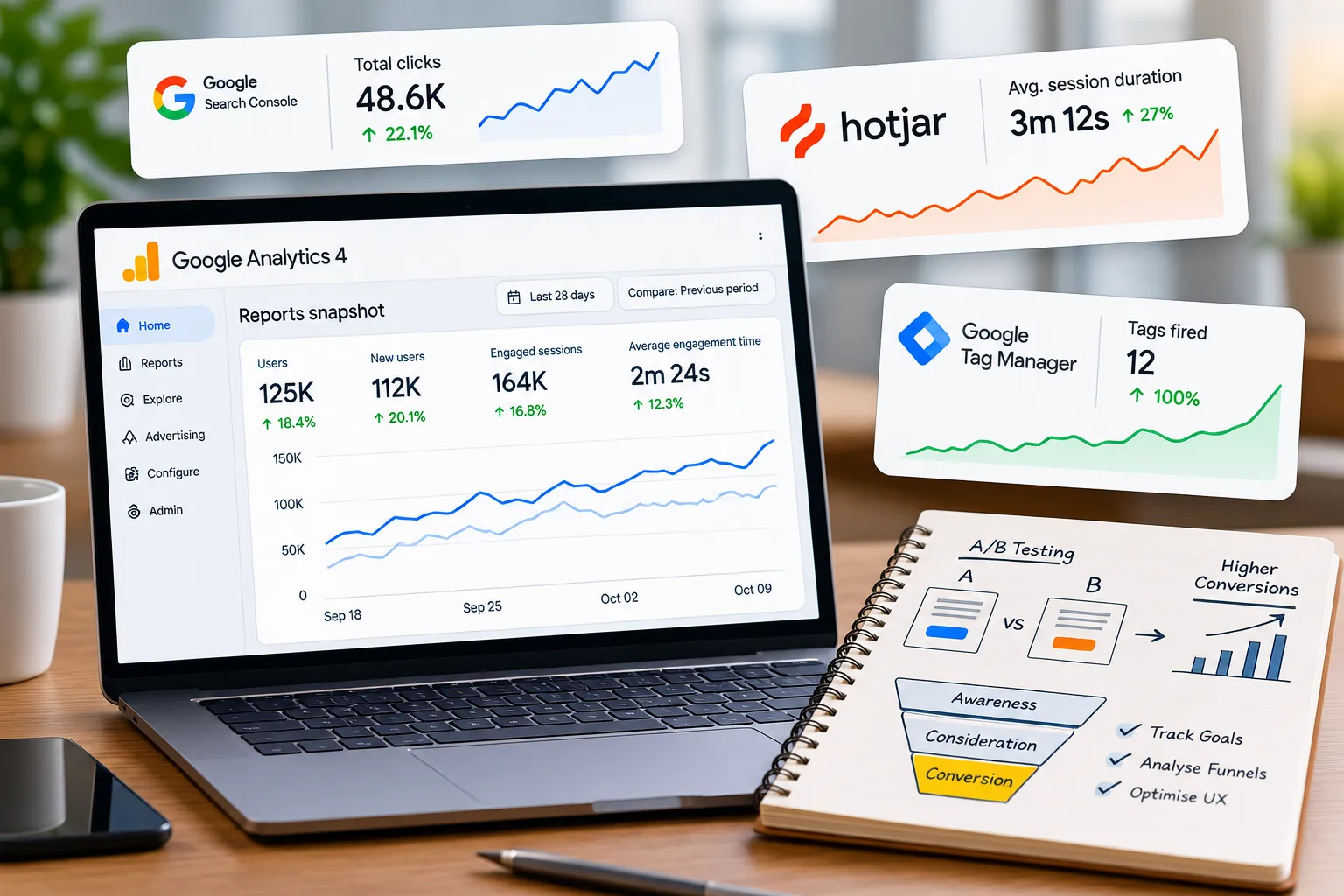
ANALYTICS & CRO · SOLUTION 18
Customers are visiting your website and interacting with your marketing. Let's understand where they come from, what they do and which activities contribute to your business.
Website traffic, advertising clicks and social media interactions provide only part of the picture. Without reliable measurement, you may not know which marketing channels attract relevant visitors, where customers lose interest or which activities generate enquiries.
We combine website analytics, conversion tracking, tag management and attribution analysis to establish a measurement system that connects customer interactions with meaningful business objectives.
Before improving your marketing, we need to understand how people discover your website and interact with it. Which channels bring visitors? Which pages do they explore? Do they engage with your services or leave before taking action?
Google Analytics 4 (GA4) provides information about traffic acquisition, engagement, landing pages and configured events. Google Search Console helps explain organic Google Search performance. Google Tag Manager supports controlled deployment of measurement tags, while UTM parameters help identify traffic associated with specific campaigns.
I configure and review GA4, its data streams and relevant traffic-acquisition reports to establish a dependable picture of website activity. This helps your business understand which channels attract visitors and how those visitors engage with your website.
I examine landing pages, engagement patterns, navigation behaviour and important interactions to identify meaningful customer journeys. These findings help your business recognise which pages hold customer interest and where further investigation is needed.
I establish appropriate campaign-tagging conventions and connect available Google Search Console information with website analytics. Consequently, your business can compare relevant acquisition channels more consistently and identify opportunities for improvement.
Understanding your customers begins with reliable information. I establish the measurement foundations that help your business distinguish useful customer activity from traffic statistics alone.
Analytics platforms use technical terms that can make even simple customer behaviour difficult to understand. I explain traffic sources, engagement and visitor journeys in familiar business language, linking the findings to the decisions you need to make.
Because of this, you can understand how customers reach your website, what attracts their attention and where your digital presence needs improvement.
A website visit does not necessarily indicate commercial interest. We need to identify which actions matter to your business and measure them accurately, whether customers submit forms, click telephone numbers, contact you through WhatsApp, make bookings or complete purchases.
Google Tag Manager supports event-trigger configuration and tag management. GA4 supports recommended and custom events and key-event measurement. Meta Pixel, Meta Conversions API and LinkedIn Insight Tag provide additional platform-specific measurement capabilities. Consent Mode v2, suitable consent-management configurations and tag diagnostics help manage applicable privacy and tracking requirements.
I define the customer interactions that matter to your business and configure relevant GA4 events and key events. This helps you measure meaningful enquiries and actions instead of treating every website interaction as equally valuable.
I implement and validate suitable Google Tag Manager triggers, Meta Pixel events, LinkedIn Insight Tag and other relevant measurement integrations. These configurations provide a clearer foundation for understanding website activity associated with different marketing platforms.
I test event firing, investigate duplicate or missing conversions and review appropriate consent behaviour across important customer journeys. As a result, your business can make decisions using more dependable measurement while respecting applicable privacy requirements.
Your analytics should reflect the actions that matter to your business. I connect technical tracking with meaningful customer interactions so that your reports become more useful.
I explain the difference between a button click, a submitted enquiry, a qualified lead and a paying customer. Each represents a different business outcome and should be communicated accurately rather than grouped under an impressive but misleading conversion total.
Because of this, you can understand what customers actually did and evaluate marketing performance without confusing activity with commercial success.
Your customers may encounter several advertisements, social media posts or search results before contacting you. We need to examine how different marketing channels contribute to their journeys while recognising that no single reporting system captures every interaction perfectly.
GA4 provides acquisition and available attribution reports. UTM parameters support campaign identification, while Meta Ads Manager and LinkedIn Campaign Manager provide platform-reported advertising conversions. Google Ads measurement, CRM records and compatible APIs can supply additional context. Attribution models, consent restrictions, cross-device journeys and reporting windows affect the comparability of results.
I analyse identifiable visitor sources, campaign information and conversion paths to understand how customers reach important actions. This helps your business recognise which channels contribute to customer interest and where further marketing investment may be justified.
I compare available GA4, advertising-platform and enquiry records, investigating differences in reported conversions and attribution methods. This enables you to evaluate marketing results more realistically rather than expecting every platform to report identical figures.
I connect available lead-management or transaction information with marketing activity where suitable integrations and data quality permit. Consequently, your business can develop a clearer understanding of which channels attract valuable enquiries and potential customers.
Marketing attribution is rarely as simple as giving one channel all the credit. I connect the available evidence to help your business understand how different activities contribute to customer acquisition.
I translate attribution findings into clear explanations and distinguish verified customer outcomes from modelled or platform-reported contributions. I avoid presenting incomplete tracking as definitive proof of which advertisement generated a sale.
As a consequence, you can compare marketing channels more intelligently, recognise measurement limitations and make better-informed investment decisions.
Analytics should remain reliable as your website, advertising campaigns and customer journeys change. New pages, updated forms, consent settings and third-party integrations can affect tracking accuracy. We need to verify important measurements regularly and maintain a consistent understanding of performance.
Google Tag Manager Preview and Tag Assistant support tag debugging. GA4 DebugView and Realtime reporting assist event validation. Meta Events Manager, Meta Pixel Helper and relevant LinkedIn diagnostics support platform-specific checks. Google Search Console, consent-management tools and scheduled reporting reviews provide additional opportunities to identify measurement problems.
I audit important tracking configurations, test customer interactions and verify that relevant events are being recorded as expected. This helps your business reduce the risk of making decisions using missing, duplicated or incorrectly configured data.
I review campaign parameters, cross-platform tag behaviour, consent-dependent measurement and relevant changes to website functionality. These checks help maintain greater consistency in reporting as your marketing systems evolve.
I document important measurement definitions, reporting limitations and recommended review procedures. Over time, this gives your business a more maintainable analytics framework and clearer confidence in the information used for decisions.
Accurate analytics requires ongoing attention, not just an initial installation. I maintain the connections between tracking technology, customer behaviour and business reporting so your data remains useful.
A reliable measurement system also needs clear documentation. I explain what each important metric means, how it is collected and what its limitations are so the information can be understood consistently by different people in your business.
Because of this, your team can interpret reports more confidently, recognise measurement problems and make decisions using clearer, more consistent information.
For businesses requiring advanced measurement architecture and larger-scale data analysis, Google Cloud, BigQuery, server-side Google Tag Manager and compatible data integration platforms such as Supermetrics, Funnel and Windsor.ai can support more complex collection, consolidation and reporting workflows.
Specialist measurement approaches such as enhanced conversions, offline conversion imports and CRM-to-advertising integrations may help provide additional customer-outcome information where supported and appropriately authorised.
Their implementation depends on data availability, platform compatibility, technical complexity, privacy requirements and the business's budget.
I design advanced measurement workflows that connect compatible website, advertising and business datasets using suitable APIs, server-side integrations and cloud services. This helps your business develop a more comprehensive understanding of customer journeys and marketing performance across systems.
I configure appropriate data transformations, event validation and reporting structures, investigating inconsistencies before combining information from different sources. Consequently, your business can analyse marketing outcomes more consistently and reduce avoidable reporting discrepancies.
I assess data quality, consent requirements, system costs and the business value of additional measurement complexity before recommending implementation. This helps your business invest in analytics capabilities that address genuine decision-making needs rather than unnecessary technical sophistication.
Advanced measurement should provide clearer answers, not simply generate more data. I connect technical analytics architecture with practical customer and business insights.
Let's build a reliable measurement system that connects website behaviour, advertising activity and customer enquiries, so you can understand your marketing performance and make better-informed business decisions.
Ready to understand where your customers come from and what drives meaningful enquiries?
ANALYTICS & CRO · SOLUTION 19
Your website is attracting visitors. Let's understand what's stopping them from taking action and improve their experience.
People may visit your website, explore your services and leave without contacting you. The problem could involve confusing navigation, unclear messaging, slow interactions, complicated forms or a lack of confidence in your offering.
We combine visitor-behaviour analysis, conversion rate optimisation, user experience research and communication strategy to identify these barriers and make evidence-based improvements that support meaningful business enquiries.
Before changing your website, we need to understand how people actually use it. Which pages do they explore? Where do they hesitate? Which information attracts attention, and at what point do they leave without taking the next step?
Google Analytics 4 provides engagement, landing-page and configured event information. Microsoft Clarity helps investigate visitor behaviour through heatmaps and session recordings. Funnel analysis, page-level comparisons and customer-journey reviews provide further context. Behavioural data must be interpreted carefully, with appropriate privacy and consent controls.
I analyse visitor journeys, landing pages, engagement patterns and important interactions to identify where potential customers lose interest. This helps your business understand which stages of the website experience need closer attention.
I examine heatmaps, session recordings and navigation behaviour to investigate overlooked content, confusing interfaces and possible usability barriers. These findings reveal opportunities to make your website easier for customers to explore and understand.
I compare behaviour across relevant devices, traffic sources and customer journeys to distinguish recurring patterns from isolated observations. As a result, your business can prioritise improvements based on meaningful evidence rather than guesswork.
Before recommending changes, I investigate how customers actually experience your website. This helps identify the barriers that may be preventing relevant visitors from becoming enquiries.
Customer behaviour often reveals where information is difficult to find or understand. I examine whether headings, service explanations and calls to action communicate what visitors need at each stage of their journey.
Because of this, your business can recognise communication gaps and provide clearer guidance when potential customers need it most.
Visitors should be able to find relevant information, compare services and contact your business without unnecessary effort. Confusing navigation, crowded pages, poorly positioned buttons and complicated forms can interrupt that journey even when your services are suitable for them.
Microsoft Clarity, GA4 and browser developer tools help investigate usability problems and relevant interactions. Responsive design testing, accessibility reviews, form analysis and UX heuristics support evaluation of navigation, information architecture, interaction states and contact pathways. Lighthouse can identify selected accessibility and technical concerns.
I review navigation, page structure, mobile layouts and important interactions to identify obstacles affecting the customer journey. This helps visitors reach relevant information more conveniently and navigate your website with less confusion.
I refine enquiry forms, button placement, information hierarchy and contact pathways while considering accessibility and device compatibility. These improvements can reduce unnecessary effort and make important customer actions easier to complete.
I evaluate the relationship between service information, trust signals and conversion opportunities across important pages. Consequently, your website can support a smoother transition from initial interest to enquiries, bookings or purchases.
Your website should help customers move forward, not make them work harder. I remove avoidable usability barriers so interested visitors can engage with your business more conveniently.
Clear communication is part of good usability. I use familiar language, logical headings, straightforward instructions and descriptive calls to action rather than vague labels or unnecessarily complicated explanations.
Because of this, visitors can understand their options, recognise the appropriate next step and contact your business with greater confidence.
A technically functional website may still struggle to generate enquiries when its message is unclear. Visitors need to understand what you offer, how your services address their needs and why they should trust your business before deciding to contact you.
Customer-journey mapping, search-intent analysis, page-content audits and available visitor-behaviour data help identify communication weaknesses. Conversion-focused content design supports improvements to headlines, value propositions, trust signals and calls to action. Genuine customer feedback and usability research can provide additional evidence.
I evaluate service descriptions, value propositions and page headlines to determine whether they address the questions prospective customers actually have. This helps your business explain its offerings more clearly and demonstrate their relevance to the intended audience.
I organise credible supporting information, authentic testimonials where available, professional credentials and relevant service details around customer decision points. These improvements can help visitors evaluate your expertise and develop greater confidence before making an enquiry.
I refine calls to action, supporting explanations and contact options to align them with different stages of customer readiness. This makes it easier for interested visitors to recognise the value of taking the next step and choose an appropriate way to contact your business.
Conversion optimisation is not about pressuring visitors. I make your services easier to understand, your expertise easier to evaluate and your contact pathways more relevant.
My experience in communication and training helps me translate complex services into simple, persuasive explanations, organise information logically and address customer concerns without flowery language or exaggerated claims.
Because of this, potential customers can recognise how your services address their needs, find credible answers and make more informed decisions about contacting you.
A redesigned page or new call to action may look better without producing better results. We need to establish a baseline, evaluate changes carefully and use the findings to decide what should be retained, refined or reconsidered.
GA4 and Google Tag Manager support measurement of relevant events and conversion pathways. Microsoft Clarity provides behavioural context. Controlled A/B testing, where practical, can compare alternative page experiences using suitable experimentation platforms. Testing requires meaningful outcome definitions, adequate sample sizes and careful interpretation of statistical uncertainty.
I define relevant conversion indicators and establish baseline performance for important pages, forms and customer journeys. This gives your business a clearer starting point for evaluating whether website improvements are producing measurable changes.
I develop improvement hypotheses and compare suitable changes to messaging, layouts, forms and calls to action using appropriate testing methods. This helps your business identify promising improvements without relying solely on visual preferences or assumptions.
I evaluate conversion results, customer behaviour and available evidence before recommending further changes. Over time, this supports a more disciplined approach to website optimisation and better-informed decisions about customer experience.
Conversion optimisation should be a process of learning, testing and improving. I connect customer behaviour with measurable outcomes so your website can evolve based on evidence rather than guesswork.
I translate testing results into straightforward explanations, distinguishing measurable improvements from inconclusive findings. I also use customer feedback and observed behaviour to refine messages that may be confusing or ineffective.
As a consequence, your business can understand which changes are helping, avoid unnecessary redesigns and make more informed decisions about improving website conversions.
For businesses requiring deeper user-experience research and structured conversion experimentation, specialist platforms such as VWO, Optimizely, Contentsquare, Hotjar, UserTesting and Maze can support selected A/B testing, customer-journey analysis, usability studies, feedback collection and behavioural research.
Their suitability depends on website traffic, conversion volume, research objectives, subscription costs and available technical resources. Small websites may benefit more from targeted usability testing than statistical A/B experiments.
I design structured usability studies and conversion experiments to investigate how customers understand, navigate and interact with important website pages. This helps your business identify specific barriers to customer action and evaluate potential improvements using more detailed evidence.
I analyse suitable experiment results, behaviour patterns and customer feedback to identify changes worth implementing. Consequently, your business can prioritise improvements that address real customer difficulties rather than repeatedly changing designs without a clear purpose.
I assess research quality, sample limitations, measurement reliability and implementation costs before recommending wider changes. This helps your business make informed conversion-optimisation investments without treating inconclusive findings as proven results.
Advanced CRO research should clarify customer behaviour and improve decisions. I combine specialist testing, practical UX judgement and clear communication to help your website work more effectively.
Let's understand how visitors experience your website, identify what's preventing them from taking action and make evidence-based improvements that create stronger opportunities for meaningful business enquiries.
Ready to turn more relevant website visits into customer enquiries?
ANALYTICS & CRO · SOLUTION 20
Your business has plenty of data. Let's turn scattered reports into clear insights that help you make better decisions.
Your website, Google Search, social media accounts and advertising campaigns may all produce reports, but their numbers often appear in different places and tell only part of the story. Without a clear understanding of what those numbers mean, it becomes difficult to evaluate performance or decide where to invest your efforts.
We combine data integration, analytics, dashboard development and business communication to organise relevant information, explain its significance and turn complex measurements into practical decisions.
Before analysing business performance, we need to identify which information matters and where it is stored. Your website, advertising platforms, social media accounts and business systems may record different parts of the customer journey. We need to organise these sources into a consistent reporting structure.
Google Analytics 4, Google Search Console, Google Ads, Meta Ads Manager and LinkedIn Analytics provide relevant digital performance information. Looker Studio connects supported data sources into reports, while Google Sheets supports structured data preparation. Compatible APIs and third-party connectors can help integrate additional sources, subject to permissions and platform limitations.
I review your existing reporting sources, marketing objectives and business questions to identify the information worth bringing together. This helps your business focus on relevant performance indicators instead of collecting unnecessary data.
I connect compatible analytics and advertising sources, standardise important reporting fields and investigate inconsistencies between datasets. These improvements provide a more organised foundation for comparing marketing performance across platforms.
I establish clear definitions for metrics, reporting periods, campaign names and customer actions, documenting important data limitations. Consequently, your team can interpret information more consistently and avoid misleading comparisons between unrelated measurements.
Useful reporting begins with reliable and relevant information. I organise your business data so different platforms contribute to a clearer understanding of performance.
Reports often become confusing because different platforms use similar terms for different measurements. I establish simple definitions and explain the purpose of each important metric before combining them into a business report.
Because of this, your team can understand what the numbers represent, recognise inconsistencies and discuss performance using a shared understanding.
Once the relevant information is organised, we need to present it in a way that answers your business questions. A useful dashboard should make important trends, comparisons and outcomes understandable without requiring you to interpret dozens of disconnected charts.
Looker Studio supports interactive reports, scorecards, tables, filters and charts from compatible data sources. Google Sheets supports supporting calculations and data preparation. GA4, Search Console and advertising-platform connectors can supply suitable reporting information. Dashboard design principles include meaningful visual hierarchy, appropriate chart selection and clear metric definitions.
I develop dashboards around practical business questions, such as which services attract visitors, which campaigns generate enquiries and how marketing performance changes over time. This helps you find relevant answers without navigating several complex reporting interfaces.
I design understandable scorecards, charts, comparisons and filters while selecting presentation formats appropriate to the underlying information. As a result, your business can recognise important trends, performance differences and potential problems more quickly.
I organise dashboards for the needs of business owners and relevant team members, with appropriate access permissions and reporting views. This makes it easier for different decision-makers to find the information relevant to their responsibilities.
A dashboard should answer business questions, not simply display attractive charts. I turn complex datasets into clear, practical views that support informed decisions.
My experience in communication and training helps me present numbers as a logical explanation. I use straightforward labels, clear comparisons and concise context instead of technical abbreviations that leave business owners guessing.
Because of this, you can understand your performance more quickly, discuss findings confidently and recognise where action may be necessary.
An increase in website traffic or advertising impressions may be positive, but we need to understand whether those changes contribute to your objectives. Reporting should distinguish general activity from enquiries, qualified leads, purchases and other outcomes that matter to your business.
GA4 provides configured event and key-event reporting, while Google Tag Manager supports suitable interaction measurement. Google Ads, Meta Ads Manager and LinkedIn Campaign Manager provide platform-reported campaign information. Looker Studio can consolidate compatible measures, while CRM records and transaction data provide additional outcome information where accessible and appropriately integrated.
I define relevant key performance indicators around your objectives, including suitable acquisition, engagement, enquiry and customer-outcome measurements. This helps your business evaluate marketing activities according to their commercial relevance rather than isolated popularity metrics.
I compare available marketing activity, conversion information and customer records to investigate relationships between channels and business results. These findings provide a clearer understanding of which activities may be contributing to meaningful customer opportunities.
I identify differences in attribution, event definitions, reporting periods and incomplete data before presenting performance conclusions. This allows your business to make more realistic decisions without treating estimated or platform-reported results as verified sales.
Not every increase in traffic or engagement represents business growth. I connect marketing performance with meaningful outcomes so you can evaluate what your investment is actually supporting.
I explain the distinction between impressions, clicks, enquiries, qualified leads and customers using familiar business language. When evidence is incomplete, I explain its limitations rather than presenting uncertain conclusions as facts.
As a consequence, your business can interpret its results more accurately, set realistic expectations and evaluate marketing activities against meaningful objectives.
Understanding performance is useful only when it leads to better decisions. Your reports should help identify what is working, where problems may be developing and which improvements deserve attention. We need to make reporting part of an ongoing business improvement process.
Looker Studio supports periodic and interactive performance reporting. GA4, Google Search Console and advertising-platform analytics provide relevant trends and comparisons. Google Sheets can support action registers, benchmarks and prioritisation frameworks. Automated reporting workflows and appropriate data-refresh schedules can reduce repetitive reporting work where supported.
I examine performance trends, relevant comparisons and changing customer behaviour to identify areas that require attention. This helps your business recognise emerging opportunities and potential problems before making unnecessary investments.
I connect the findings with practical recommendations for website improvements, content priorities, campaigns and customer communication. Consequently, your team can focus on actions supported by available evidence rather than disconnected assumptions.
I establish suitable reporting cycles, performance reviews and follow-up priorities to assess the effect of implemented changes. Over time, this supports a more consistent process of learning, improving and allocating business resources effectively.
Good reporting should change what your business does next. I convert performance data into understandable recommendations and help establish a cycle of measurement, action and improvement.
I present findings as clear business explanations: what changed, why it may have changed, what the evidence supports and what should be considered next. My communication experience helps turn technical analysis into useful discussions and practical decisions.
As a consequence, your business can act on insights more confidently, communicate priorities clearly and make better-informed decisions about future growth.
For businesses handling larger datasets or requiring more sophisticated business intelligence, platforms such as Google BigQuery, Google Cloud, Microsoft Power BI and Tableau can support advanced data modelling, interactive visualisation and complex reporting.
Data integration services such as Supermetrics, Funnel and Windsor.ai can help consolidate information from compatible marketing platforms. Python and SQL can support data preparation, transformation, validation and customised analytical processes.
Advanced predictive analysis and forecasting may also be appropriate when sufficient historical data, clear business objectives and reliable assumptions are available.
I design appropriate data integration and reporting architectures using compatible connectors, APIs, SQL, Python and cloud services where justified. This helps your business bring complex datasets together and develop a more comprehensive understanding of marketing and operational performance.
I develop customised dashboards, analytical models and relevant forecasting approaches while evaluating data quality and methodological limitations. As a result, your business can identify deeper performance patterns and assess important decisions using more structured evidence.
I evaluate implementation costs, ongoing maintenance requirements, data security and expected business value before recommending advanced analytical systems. This helps your business invest in capabilities that address genuine needs without introducing unnecessary technical complexity.
Advanced business intelligence should make decisions clearer, not create more complicated reporting. I connect specialist analysis with practical business understanding and effective communication.
Let's bring your important data together, create understandable dashboards and turn performance insights into practical decisions that support smarter marketing and sustainable business growth.
Ready to turn scattered reports into meaningful business insights?
SERVICE 06 / 06
Reduce repetitive work and make business information easier to use. I develop suitable automations, connect applications through APIs, build practical AI-assisted workflows and create custom website features or software when standard tools cannot meet your requirements. Every solution is planned around reliability, clear communication, human oversight and operational value.
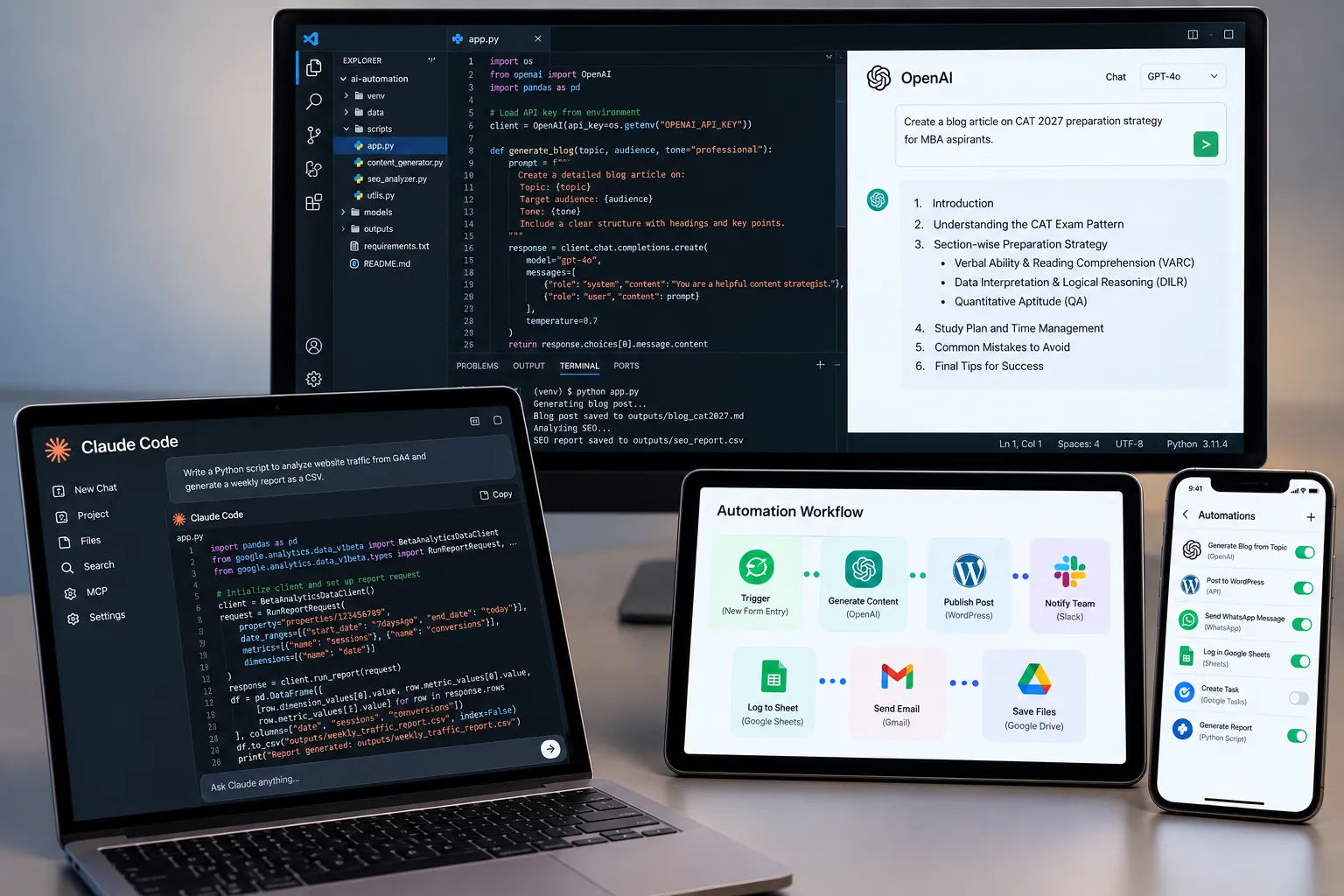
AI, AUTOMATION & APP DEVELOPMENT · SOLUTION 21
Your team spends valuable time on repetitive work. Let's automate routine processes so they can focus on customers and business growth.
Manually transferring information, organising enquiries, sending reminders and updating records can consume hours of productive time. These repetitive activities can also cause delays, inconsistencies and missed follow-ups when your business becomes busier.
We combine workflow analysis, n8n automation, Python development, APIs and customer communication to build practical systems that reduce repetitive work, organise important information and support more reliable business operations.
Before introducing automation, we need to understand how your business operates. Which activities are repeated every day? Where does information need to be entered more than once? Which tasks cause delays, and which decisions still require human judgement?
Process mapping, workflow diagrams and task-frequency analysis help document existing operations. n8n provides visual workflow orchestration, while Python can support data processing and custom business logic. Google Sheets, Forms and supported application APIs can provide examples of existing information flows and automation opportunities.
I examine your existing business processes, recurring tasks and information flows to identify activities suitable for automation. This helps your business recognise where automation can save time, reduce repetitive effort and improve operational consistency.
I evaluate task frequency, complexity, potential errors and business impact to prioritise workflows with practical value. As a result, your business can focus its investment on processes where automation is more likely to produce worthwhile improvements.
I distinguish rule-based activities from tasks requiring customer sensitivity, professional judgement or approval, then develop suitable workflow requirements. This helps your team retain control over important decisions while reducing unnecessary manual work.
Automation should solve operational problems, not introduce technology for its own sake. I identify repetitive work that can be simplified while keeping essential business decisions under human control.
My experience in training and communication helps me understand how employees describe their work, identify misunderstandings between teams and document processes in straightforward language. I translate operational requirements into instructions that both business users and technical systems can follow.
Because of this, your team can understand which activities will change, what the automated system will handle and when human involvement will still be necessary.
Once suitable tasks have been identified, we need to connect their individual steps into dependable workflows. Information should move between authorised systems without repeated copying, and routine actions should occur at the appropriate stage of a business process.
n8n supports trigger-based and scheduled workflows, application integrations, webhooks, conditional logic and error handling. Python supports customised data validation, transformations and processing. REST APIs and supported connectors can exchange information with services such as Google Sheets, Gmail, Google Drive and compatible business applications. Authentication, logging and retries help make workflows more dependable.
I develop n8n workflows that connect suitable triggers, conditions and business actions, including recurring updates, notifications and record management. This helps your business reduce repeated manual activities and complete routine processes more consistently.
I use Python and appropriate API integrations to validate, transform and transfer information between compatible systems. These processes help your team reduce duplicate data entry and maintain more organised operational records.
I configure suitable validation checks, error handling, retries and notification mechanisms for important workflows. Consequently, your business can identify failed operations more quickly and reduce the risk of unnoticed processing problems.
A useful automation system must be dependable as well as efficient. I combine workflow design, coding and appropriate safeguards to make routine operations easier to manage.
Automated messages, notifications and task descriptions must clearly explain what has happened and what requires attention. I develop understandable status messages, logical labels and practical instructions rather than exposing users to unnecessary technical details.
Because of this, employees can understand automated updates, identify tasks requiring attention and work with the system more confidently.
Customer enquiries may arrive through website forms, email, WhatsApp and other communication channels. When these are handled separately, important information can be overlooked and follow-ups may be delayed. We need a structured way to capture, organise and respond to enquiries without making customer communication impersonal.
n8n, webhooks and supported APIs can connect authorised enquiry sources with compatible CRM systems, spreadsheets and notification services. HubSpot, Zoho CRM, Gmail and supported WhatsApp Business integrations can provide relevant capabilities depending on account access and platform requirements. Automated acknowledgement, lead assignment, reminders and status tracking can be implemented through suitable workflows. Messaging permissions, consent and approved templates may apply.
I design workflows that collect enquiries from supported channels and organise relevant details into a consistent lead-management process. This helps your business reduce scattered records and maintain clearer visibility into potential customer opportunities.
I implement suitable acknowledgement messages, internal notifications, lead assignments and follow-up reminders, with human review where appropriate. As a result, your team can respond more systematically and reduce avoidable delays in customer communication.
I develop lead-status tracking, exception handling and appropriate escalation processes so important enquiries can receive further attention. These improvements help your business manage customer conversations more reliably without depending entirely on individual memory or manual reminders.
A customer enquiry should not disappear between disconnected inboxes and spreadsheets. I create structured workflows that support timely responses, clearer responsibilities and dependable follow-up.
Automated customer communication must feel relevant and understandable rather than mechanical. I develop concise acknowledgements, clear next-step instructions and appropriate follow-up messages that respect customer expectations and preserve opportunities for personal interaction.
Because of this, customers can receive clearer information about their enquiries, understand what happens next and experience more consistent communication with your business.
An automation that works today may require attention when application permissions, business requirements or external services change. We need to monitor important workflows, recognise failures and evaluate whether automation is genuinely reducing effort and improving business operations.
n8n execution history and error workflows support operational monitoring and diagnostics. Python logging, API response validation and suitable notification mechanisms help investigate processing failures. Google Sheets, Looker Studio and compatible reporting systems can support workflow-performance summaries. Version management, secure credential handling and periodic access reviews contribute to maintainability.
I establish appropriate workflow monitoring, execution logs and failure notifications for important automated processes. This helps your business identify operational interruptions and address problems before they remain unnoticed for extended periods.
I review processing outcomes, manual interventions, data accuracy and recurring exceptions to identify opportunities for improvement. These findings help your team understand whether automation is reducing workload and where additional refinement may be necessary.
I document workflow dependencies, ownership, permissions and maintenance requirements while refining processes as business needs evolve. Over time, this supports more maintainable automation systems and greater operational confidence as your business grows.
Automation is valuable when it continues to work reliably. I combine monitoring, practical maintenance and business analysis to help automated processes remain useful over time.
I convert workflow activity and technical errors into clear operational reports, explaining what succeeded, what failed and which actions require attention. This makes the system understandable to business owners and employees who do not need to know the underlying code.
As a consequence, your team can recognise operational problems sooner, understand the performance of automated processes and make informed decisions about further improvements.
For businesses requiring more complex workflow orchestration, process intelligence or customer-management automation, specialist technologies such as Microsoft Power Automate, UiPath, Camunda and advanced n8n deployments can support selected business-process integrations, robotic process automation and multi-stage workflows.
Platforms such as HubSpot and Zoho CRM can provide more sophisticated lead-management capabilities, while Google Cloud, appropriate databases and Python services can support larger data-processing requirements.
AI-assisted classification, summarisation and routing may also be appropriate for selected workflows, provided that their accuracy, security and human-review requirements are carefully assessed.
I evaluate complex business workflows, application dependencies and operational constraints to determine whether advanced automation capabilities offer meaningful advantages. This helps your business identify opportunities for greater operational efficiency without investing in unnecessary technology.
I design suitable integrations, approval stages, exception-handling procedures and monitoring requirements for multi-step processes. As a result, your business can manage more complex workflows while retaining appropriate oversight of important operations.
Where justified, I evaluate AI-assisted workflow components, test their outputs and establish relevant validation and human-review mechanisms. This allows your business to explore additional automation opportunities while managing accuracy, privacy and operational risks.
Advanced automation should address genuine operational complexity. I combine process understanding, technical development and practical safeguards to create systems that support business efficiency and control.
Let's automate suitable business processes, organise customer enquiries and build reliable workflows that reduce manual effort, support timely communication and improve operational efficiency.
Ready to make your business processes more efficient through automation?
AI, AUTOMATION & APP DEVELOPMENT · SOLUTION 22
Your business applications hold important information. Let's connect them so your systems work together instead of creating more manual work.
Your website, CRM, email, spreadsheets, payment systems and marketing platforms may each handle different parts of your business. When they cannot share information reliably, your team may have to repeat data entry, reconcile inconsistent records and switch constantly between applications.
We combine API integration, Python development, n8n workflows and data-management principles to connect compatible business systems, improve information flow and reduce unnecessary manual effort.
Before connecting business applications, we need to understand what each system does, what information it holds and where that information needs to go. We must identify which systems should exchange data, what triggers those exchanges and which application should remain the reliable source of each record.
API documentation, process mapping and data-flow diagrams help establish integration requirements. REST APIs, JSON, webhooks and application connectors support different methods of exchanging information. Tools such as Postman and API testing environments help investigate available endpoints, authentication requirements and data structures.
I review your existing applications, workflows and information requirements to identify where disconnected systems create unnecessary effort or inconsistent records. This helps your business understand which integrations could improve operations and reduce repeated work.
I map the required data exchanges, identify the appropriate source of each record and define how information should move between compatible systems. This establishes a clearer integration plan that reduces confusion and unnecessary duplication.
I evaluate available APIs, authentication methods, platform restrictions and implementation complexity before recommending an approach. Consequently, your business can choose practical integrations that fit its requirements, resources and existing technology.
Connecting applications begins with understanding how your business uses information. I plan integrations that solve genuine operational problems rather than connecting systems simply because the technology allows it.
Different teams may use different names for the same information or interpret business processes differently. I translate their requirements into clear data definitions, workflow descriptions and responsibilities that both business users and developers can understand.
Because of this, your team can understand which systems are being connected, what information will be exchanged and how the integration will support everyday work.
Once the integration requirements are clear, we need to establish reliable communication between the relevant applications. Information should move securely and accurately, whether the process begins with a customer enquiry, an order, a form submission or an update in another business system.
REST APIs, JSON payloads and webhooks enable supported applications to exchange information. n8n provides workflow orchestration and API connectors. Python supports custom integration logic, data transformations and requests to compatible services. OAuth 2.0, API keys and other documented authentication mechanisms provide controlled access. Postman supports endpoint testing and troubleshooting.
I develop and configure API integrations that allow authorised business applications to exchange information according to defined workflows. This helps your business reduce repeated data entry and maintain more connected operations.
I use n8n and Python to handle application requests, webhooks, data transformations and conditional processing where standard connectors are insufficient. These capabilities help your systems exchange useful information in the formats and sequences required by your business.
I implement appropriate authentication, request validation, error handling and retry behaviour to improve integration reliability. As a result, your team can depend more confidently on connected workflows and recognise problems when data exchanges fail.
An effective integration should make technology less visible in daily operations. I connect applications so information moves appropriately without requiring your team to manage every transfer manually.
Technical integrations also need understandable operational messages. I develop clear notifications and error explanations that help employees recognise whether an exchange succeeded, failed or requires attention.
Because of this, your team can work more confidently with connected systems and understand when human intervention is necessary.
Connecting applications is not enough if they exchange incorrect, incomplete or duplicate information. Your business needs consistent records, clear rules for updates and suitable checks to prevent one system from introducing problems into another.
Python supports data validation, transformation, deduplication and structured processing. n8n supports conditional logic and workflow controls. APIs may provide identifiers, timestamps, pagination and update mechanisms needed for synchronisation. Techniques such as idempotent processing, reconciliation checks, logging and controlled conflict resolution help improve data consistency.
I define appropriate data mappings, validation rules and transformation processes so information can be interpreted correctly by receiving applications. This helps your business maintain more accurate and usable records across connected systems.
I design suitable synchronisation rules, duplicate-detection checks and conflict-handling procedures for important business information. These measures can reduce contradictory records and unnecessary manual corrections.
I establish reconciliation procedures and operational checks to identify missing, outdated or unsuccessful data transfers. Consequently, your business can recognise information gaps sooner and maintain greater confidence in its connected workflows.
Business integrations should improve information quality, not spread errors between systems. I combine data-management discipline with technical development to keep connected records more dependable.
I establish clear definitions for customer details, statuses, transaction information and other important fields so different teams interpret shared records consistently.
Because of this, employees can work with clearer information, understand record statuses and make decisions with fewer misunderstandings.
Business applications change over time. Access permissions may expire, API limits may change and new business requirements may affect how information needs to move. We must ensure integrations remain secure, observable and maintainable as your operations develop.
API authentication and permission management help control access to connected systems. n8n execution logs, Python logging and suitable application-monitoring services support diagnostic reviews. Secret management, transport encryption, webhook verification, rate-limit handling, retry policies and version documentation contribute to secure and maintainable integrations.
I review authentication arrangements, access permissions and sensitive-data handling to establish appropriate safeguards for connected applications. This helps your business reduce avoidable security risks and retain better control over information access.
I configure suitable execution monitoring, error notifications, logging and recovery procedures for important integrations. These measures help your team identify failed exchanges and respond to operational problems more effectively.
I document integration dependencies, important data flows and maintenance requirements, reviewing them when applications or business processes change. Over time, this supports more dependable system connections and reduces unnecessary disruption as your business evolves.
Connected systems should remain reliable beyond their initial setup. I combine security, monitoring and maintainable development practices to support long-term business operations.
I translate technical failures, permission problems and system updates into understandable explanations and actionable instructions. This makes integration management more accessible to business owners and non-technical employees.
As a consequence, your team can understand system issues more quickly, maintain clearer operational responsibilities and make informed decisions about future improvements.
For businesses managing more complex application environments, specialist integration technologies such as MuleSoft Anypoint Platform, Boomi, Azure Logic Apps, Google Cloud Application Integration and Apache Kafka can support enterprise integration, asynchronous messaging and event-driven architectures.
API management technologies such as Azure API Management and Google Cloud API Gateway can provide additional capabilities for securing, governing and monitoring suitable API services.
Python-based integration services, containerised applications, managed queues and cloud databases may also be appropriate where standard workflows cannot meet the requirements for scale, reliability or custom processing.
I evaluate complex integration requirements, system dependencies, data volumes and operational constraints to determine whether advanced integration technologies are justified. This helps your business select an architecture that supports its actual requirements without unnecessary cost or complexity.
I design appropriate integration approaches involving APIs, event-driven communication, custom Python services and suitable cloud infrastructure where needed. These capabilities can help your business manage more complex information flows and support future system expansion.
I assess authentication, data protection, monitoring, maintenance responsibilities and the long-term cost of the proposed system. Consequently, your business can make better-informed technology investments and retain greater control over its connected operations.
Advanced integration should make systems work together more effectively. I connect technical architecture with business requirements to develop practical, maintainable solutions.
Let's connect your existing systems, simplify information exchange and develop reliable integrations that reduce duplication, improve data consistency and support more efficient business operations.
Ready to make your business applications work together?
AI, AUTOMATION & APP DEVELOPMENT · SOLUTION 23
You want to use AI in your business. Let's identify where it can genuinely save time, improve decisions and make your work more efficient.
Artificial intelligence can help businesses organise information, analyse documents, develop content and support repetitive knowledge-based tasks. But adopting AI without understanding its limitations can create inaccurate outputs, unnecessary costs and new operational problems.
We combine business-process analysis, Python development, AI models, data workflows and communication strategy to identify practical AI applications and develop systems that support your team without replacing essential human judgement.
Before introducing AI tools, we need to understand your business processes, recurring information needs and the decisions your team makes. Not every task requires artificial intelligence. We should identify where it offers practical advantages over ordinary software, manual procedures or simpler automation.
Business-process mapping, task analysis and controlled evaluations help identify suitable AI use cases. Platforms such as ChatGPT, Claude and Gemini provide capabilities for language understanding, summarisation, drafting and information analysis. Python supports experimental workflows and evaluation scripts, while n8n can connect suitable AI services with authorised business processes through supported APIs.
I examine your recurring information tasks, customer interactions and operational challenges to identify where AI could provide meaningful assistance. This helps your business focus on applications that address genuine needs rather than adopting AI simply because it is popular.
I compare AI-assisted approaches with conventional software, rule-based automation and existing employee workflows, considering accuracy, costs and required oversight. This allows your business to choose an appropriate solution without introducing unnecessary complexity or expense.
I develop small, controlled demonstrations and evaluate their usefulness against real business examples before recommending broader adoption. Consequently, your team can understand the practical benefits and limitations before committing resources to implementation.
AI should solve identifiable business problems, not become an additional problem to manage. I connect its capabilities with practical requirements, realistic expectations and measurable value.
My experience in training and communication allows me to explain AI capabilities in simple, familiar language, distinguish realistic applications from exaggerated claims and help employees understand how the technology supports their work.
Because of this, your team can recognise where AI may be useful, understand its limitations and make informed decisions about adopting it.
Your business may have information spread across spreadsheets, documents, reports, emails and databases. Finding relevant details, organising records and preparing summaries can take considerable time. We need to make this information easier to process and use without compromising accuracy or confidentiality.
Python libraries such as pandas support structured data preparation and analysis. Compatible document-processing tools and AI APIs can help extract and classify information from supported files. Models from OpenAI, Anthropic and Google can assist with summarisation, classification and natural-language analysis. Structured outputs, schema validation, database queries and appropriate access controls can improve reliability.
I develop Python-based workflows to organise, clean, classify and transform suitable business information into more consistent formats. This helps your team reduce repetitive data preparation and work with information that is easier to analyse.
I integrate appropriate AI models to summarise authorised documents, extract relevant details and identify useful patterns, validating outputs against the original information. These capabilities can help employees find important information more quickly and reduce the time spent reviewing large volumes of material.
I design structured outputs, validation checks and suitable review processes to identify missing information, inconsistent records and potentially inaccurate AI responses. As a result, your business can use AI-assisted information more responsibly while retaining control over important decisions.
Your business information should support decisions rather than consume hours of manual processing. I combine Python, data analysis and appropriate AI capabilities to make information easier to organise, understand and use.
A useful analysis should not require business owners to understand programming or machine-learning terminology. I present findings in straightforward language, explain their limitations and organise conclusions around the questions your team needs answered.
Because of this, employees can understand complex information more comfortably, recognise important findings and use them to support practical business decisions.
Employees and customers often need answers from existing business information, such as policies, service details, product documentation and internal procedures. AI assistants can help locate and explain relevant information, provided that their sources, permissions and limitations are properly managed.
LLM APIs, Python and n8n support the development of task-specific AI workflows. Retrieval-Augmented Generation (RAG) can connect language models with authorised documents through indexing, embeddings and suitable search mechanisms. Vector-search systems such as pgvector or supported managed retrieval services can help locate relevant material. Structured tool calling, access controls, source references and human-review mechanisms support safer operation.
I organise approved business documents and information sources into suitable knowledge structures for AI-assisted retrieval. This helps employees locate relevant information more conveniently without repeatedly searching through disconnected files.
I develop task-focused AI assistants that retrieve appropriate information, prepare useful responses and perform authorised operations through suitable integrations. These systems can help your business handle recurring information requests more efficiently while maintaining clearer operational boundaries.
I implement appropriate access restrictions, source referencing, response validation and escalation rules for uncertain or sensitive situations. This helps your team use AI-generated assistance with greater confidence and recognise when human judgement is required.
A useful AI assistant should work with your business knowledge, not invent answers. I build practical, controlled systems that combine accessible information, clear responsibilities and appropriate human oversight.
AI-generated responses must reflect your business accurately and use language customers and employees understand. I develop response guidelines, clear explanations and consistent terminology while avoiding unsupported claims or unnecessarily complex wording.
Because of this, users can receive more understandable information, identify appropriate next steps and know when a matter requires personal assistance.
An AI system may produce useful responses in one situation and unreliable results in another. Changes in business information, model behaviour and user requirements can affect its performance. We need to test the system with realistic examples, monitor important outcomes and improve it responsibly.
Python-based evaluation scripts, structured test datasets, application logging and suitable LLM evaluation frameworks can support accuracy and reliability assessment. LangSmith, Langfuse and comparable observability tools can assist with tracing and evaluation where appropriate. n8n execution logs, API usage reporting and suitable feedback mechanisms can provide additional operational evidence.
I develop representative test cases and evaluation criteria for factual accuracy, task completion, consistency and appropriate handling of uncertain requests. This helps your business understand where its AI workflows perform reliably and where additional safeguards are required.
I examine system responses, processing failures, latency and usage costs to identify operational problems and opportunities for improvement. These findings help your team recognise unreliable behaviour, manage operating expenses and maintain more dependable AI-assisted processes.
I refine prompts, retrieval processes, validation rules and human-review requirements based on observed results and changing business needs. Over time, this supports more maintainable AI applications that remain aligned with your operational objectives.
Reliable AI requires testing, monitoring and continuous improvement. I combine technical evaluation with practical business judgement so AI remains a useful tool rather than an unquestioned source of decisions.
I explain AI performance through understandable examples, identifying what the system handled correctly, where it struggled and which safeguards are necessary. I also help employees interpret AI outputs without assuming that confident language means factual accuracy.
As a consequence, your business can understand the strengths and limitations of its AI systems, manage risks more effectively and make informed decisions about future improvements.
For businesses requiring more advanced AI applications, specialist technologies such as LangChain, LangGraph, LlamaIndex, LangSmith and Langfuse can support selected AI orchestration, knowledge retrieval, tracing and evaluation workflows.
Cloud platforms such as Google Vertex AI, Microsoft Azure AI and Amazon Bedrock offer additional managed capabilities for AI model access, application development and governance. Vector databases and search technologies, including Pinecone, Weaviate and pgvector, can support more extensive knowledge-retrieval requirements.
Advanced approaches such as model fine-tuning, specialised document processing and multi-step AI agents may be appropriate when simpler solutions cannot satisfy the business requirements.
These systems introduce additional considerations involving model costs, evaluation, data security, provider terms, access permissions and ongoing maintenance.
I investigate complex AI requirements, knowledge sources, model capabilities and integration constraints to determine whether advanced architectures are justified. This helps your business select appropriate AI capabilities without investing unnecessarily in sophisticated systems.
I design and evaluate suitable retrieval, reasoning, orchestration and data-processing workflows using Python, compatible AI frameworks and cloud services. These capabilities can help your business handle more demanding information tasks and develop specialised AI-assisted applications.
I establish evaluation criteria, monitoring processes, access controls and appropriate human approval mechanisms before recommending wider operational use. As a result, your business can explore advanced AI opportunities while maintaining stronger oversight of accuracy, security and operational costs.
Advanced AI should provide additional capability only when it delivers meaningful business value. I connect specialist technology with practical problem-solving, systematic evaluation and human judgement.
Let's identify practical AI opportunities, organise business information more effectively and develop reliable workflows that save time, support better decisions and keep important operations under your control.
Ready to discover where AI can genuinely help your business?
AI, AUTOMATION & APP DEVELOPMENT · SOLUTION 24
Your business needs functionality that standard software cannot provide. Let's build a solution designed around the way you actually work.
Off-the-shelf software can handle many common business requirements, but it may not support your particular workflows, customer interactions or operational needs. Trying to force your processes into unsuitable systems can create inefficiencies, unnecessary subscriptions and complicated workarounds.
We combine software architecture, full-stack development, database design, API integration and business-process understanding to develop practical applications and custom website features aligned with your requirements.
Before developing an application, we need to understand what your business is trying to achieve. Who will use the system? Which problems must it solve? What information will it handle, and how should it fit into your existing operations? These questions help determine whether a custom application is necessary and what it should include.
Business requirements analysis, user stories, process mapping, wireframes and technical feasibility assessments support software planning. WordPress, WooCommerce, Advanced Custom Fields (ACF), Python and JavaScript can provide different development options depending on the requirements. Database modelling, API specifications and application architecture planning help establish a maintainable foundation.
I analyse your business processes, user requirements and existing software to determine which capabilities genuinely require custom development. This helps your business avoid unnecessary software investment and focus on functionality that addresses its actual needs.
I define user journeys, essential features, access requirements and integration needs, prioritising a practical initial release. As a result, your business can begin with a manageable solution that delivers useful functionality without unnecessary complexity.
I evaluate appropriate development technologies, database structures and application architecture based on maintainability, security and future requirements. This creates a clearer technical foundation for reliable development and future expansion.
Custom software should be built around the problem it solves, not the technology used to develop it. I translate your business requirements into a practical application plan.
My experience in communication and training helps me understand requirements from both technical and non-technical stakeholders. I translate business expectations into clear specifications and explain proposed functionality without unnecessary jargon.
Because of this, your team can understand what the application will do, how it will support existing work and which features should receive priority.
Once the requirements are clear, we need to build functionality that customers and employees can use comfortably. Whether the project involves a booking system, registration portal, learning platform, product configuration tool or internal dashboard, the application should make important tasks easier to complete.
WordPress, WooCommerce, ACF, PHP, HTML, CSS and JavaScript support custom website features, dynamic content and administrative interfaces. Python and suitable backend frameworks can support standalone applications and specialised processing. SQL databases, REST APIs and reusable interface components support structured information management and application functionality. Claude Code and other appropriate AI-assisted development tools may support coding, review and testing under developer supervision.
I develop custom WordPress functionality, dynamic interfaces, forms, dashboards and business-specific features that extend beyond standard templates or plugins. This allows your business to offer more suitable customer interactions and manage specialised processes through its website.
I build appropriate frontend and backend components, including user interfaces, business rules, database interactions and controlled access to application features. These capabilities help employees and customers complete important tasks through workflows designed around their actual requirements.
I develop responsive layouts, clear navigation, suitable validation and accessible interactions across relevant devices. Consequently, your application becomes easier to understand, more practical to use and better aligned with everyday business operations.
A custom application should simplify work for the people who use it. I combine hands-on development with user experience and communication principles to create purposeful, maintainable software.
A technically capable application can still fail when its screens and instructions are confusing. I use familiar words, logical navigation, descriptive labels and understandable feedback messages to make interactions easier for non-technical users.
Because of this, customers and employees can learn the application more easily, complete tasks with fewer misunderstandings and use its features more confidently.
A custom application rarely operates in isolation. It may need to exchange information with your website, payment services, CRM, spreadsheets, email systems or other authorised platforms. These connections should support your business processes without creating inconsistent records or unnecessary manual work.
REST APIs, JSON, webhooks and documented authentication methods support integration between compatible applications. Python and JavaScript can implement custom integration logic, while n8n can orchestrate suitable workflows. SQL databases, data-validation rules and synchronisation mechanisms support structured information management. Secure credential handling and appropriate access controls protect connected services.
I design and implement appropriate integrations between custom applications and authorised business systems using available APIs and webhooks. This helps your business reduce disconnected processes and move relevant information between compatible platforms.
I develop data models, validation rules, processing logic and suitable synchronisation workflows to manage important records. These improvements support more accurate information handling and reduce avoidable duplication across systems.
I establish appropriate authentication, permissions, error handling and audit information for important operations and integrations. As a result, your business can maintain stronger control over application access and recognise problems affecting data exchange.
Your custom application should fit into your business, not become another disconnected system. I connect application functionality with relevant information and operational workflows to create a more coherent technology environment.
Connected systems often use different labels, statuses and processes. I define information and interaction requirements clearly so that customers and employees receive understandable messages and consistent explanations.
Because of this, your team can interpret shared information more accurately, recognise important updates and manage connected processes with fewer misunderstandings.
An application needs to work reliably beyond its first release. Changes to business requirements, software dependencies, devices and connected services can introduce problems. We need to validate essential functionality, protect information and establish a practical approach to future improvements.
Git-based version control, automated and manual testing, code review and appropriate staging environments support reliable development. PHP and Python testing tools, browser developer tools, API testing and security reviews help assess functionality and operational risks. Logging, monitoring, backups, dependency updates and database maintenance support ongoing application management. AI-assisted coding tools require independent validation of generated changes.
I test important user journeys, business rules, forms, APIs and database operations to identify functional defects before release. This helps your business reduce avoidable disruption and provide a more dependable experience for customers and employees.
I review access controls, input validation, error handling, sensitive-data practices and software dependencies according to the application's risk profile. These safeguards help reduce preventable security and reliability problems while protecting important business information.
I establish suitable maintenance procedures, document important functionality and prioritise improvements based on operational feedback. Over time, this supports a more maintainable application that can adapt to changing business requirements.
Software development doesn't end when an application goes live. I combine systematic testing, security awareness and ongoing improvement to help custom solutions remain useful and dependable.
I explain application changes, known limitations and maintenance requirements in straightforward language. I also create understandable user instructions and operational documentation so employees know how to use the system and report problems.
As a consequence, your team can adopt new functionality more confidently, understand important changes and make informed decisions about future development.
For businesses requiring more complex applications, scalable infrastructure or specialised software capabilities, technologies such as React, Next.js, FastAPI, Django, PostgreSQL and Redis can support suitable frontend, backend, database and performance requirements.
Google Cloud, Microsoft Azure and Amazon Web Services can provide managed hosting, databases, application deployment and related infrastructure services. Docker and appropriate continuous integration and deployment workflows can support repeatable development and release processes.
AI-assisted development tools such as Claude Code, GitHub Copilot and suitable coding assistants can help with selected programming, refactoring, test generation and code-review activities. Their outputs still require professional supervision, security checks and functional validation.
Advanced architecture should be considered only where application complexity, expected usage, security requirements and business value justify the additional implementation and maintenance costs.
I evaluate application scale, performance requirements, data relationships and expected business growth to determine whether more advanced software architecture is appropriate. This helps your business choose technology that supports its actual needs without unnecessary development costs.
I design appropriate application components, database structures, API services and deployment workflows, incorporating AI-assisted development where it offers practical value. As a result, your business can develop more capable software while maintaining clearer control over functionality, maintainability and future expansion.
I assess security, testing requirements, infrastructure costs, software dependencies and ongoing maintenance before recommending complex technical solutions. This helps your business make informed application-development investments and reduce avoidable operational risks.
Advanced development should serve a clear business purpose. I combine software engineering, AI-assisted tools and practical business understanding to build applications that solve real operational problems.
Let's develop a practical application or custom website feature that solves your specific challenges, simplifies important workflows and provides a maintainable foundation for future business growth.
Ready to build software designed around your business?
LET'S TURN YOUR DIGITAL PRESENCE INTO BUSINESS GROWTH
Your website, marketing, communication and technology should contribute to measurable business results. Let's identify opportunities to attract relevant customers, generate more qualified enquiries, improve conversions and make better use of your marketing budget.
Let's discuss what will help your business grow.
Back to the problems I solve